
Samsung to End MLC NAND, 2026 Flash Supply Tight


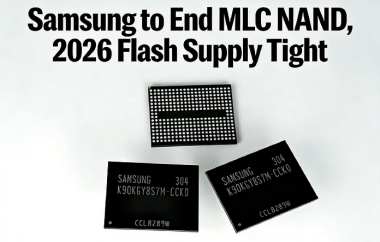
According to industry reports, Samsung Electronics plans to officially phase out MLC NAND production in March 2025 and gradually shift capacity toward more advanced 3D NAND processes. This transition is expected to significantly tighten overall NAND Flash supply by 2026, raising the risk of a deeper supply–demand imbalance.
Market sources suggest that Samsung's NAND Flash contract prices could jump by more than 100% in the first quarter of 2026. As MLC NAND shipments wind down, Samsung is set to repurpose cleanroom space for DRAM manufacturing, while its NAND lines move toward higher-layer 3D NAND technologies, including 236-layer V8 and 290-layer V9 stacks. Early-stage yield challenges during this process upgrade could further limit effective output.
Data shows that around 75% of Samsung's NAND output in 2025 already comes from 3D NAND, with the remainder based on older nodes. By the fourth quarter of 2026, Samsung is expected to become the world's first major player to fully transition to 3D NAND production. Over the same period, MLC NAND's share of total market shipments is projected to fall from 1.3% in 2024 to roughly 0.5–0.6% by 2026.
Despite the decline, demand for MLC NAND remains steady in industrial control, automotive, and medical applications, where long write endurance and reliability are critical. Against this backdrop, manufacturers such as Macronix are likely to step in as key MLC NAND providers. Macronix plans to ramp MLC NAND capacity from the second half of 2025, reallocating about 4,000–5,000 wafers per month to meet ongoing demand.
Industry analysts note that as global memory makers continue to scale back legacy process nodes, the NAND Flash market is moving toward a tighter, seller-driven environment.


