
DIY 48V Phantom Power for Condenser Mics


If you're interested in DIYing a 48V phantom power supply for condenser microphones, you might want to check out this article.
48V phantom power is what many active professional microphones need. Here's a simple 48V phantom power circuit that works for most professional mics except tube microphones.
The detailed circuit diagram is as follows:
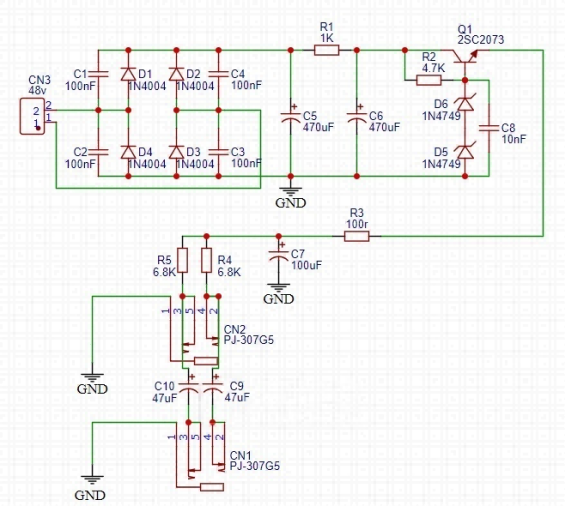
The transformer in this circuit outputs AC 48V, which is not easy to find as a ready-made part. You can use a dual 24V transformer of around 10W. In this case, the center tap of the transformer isn't used, and the two ends give you 48V.
D5 is a 48V Zener diode. Zener diodes can be connected in series, so here we use two 24V 1N4749 Zener diodes in series to get 47V. Because each Zener has about a 0.5V voltage drop, two in series give about 1V drop.
The XLR socket CN2 connects to the microphone, and CN1 connects to the preamp, both carrying balanced signals.
C10 and C9 are DC-blocking capacitors to prevent the phantom 48V from being applied directly to the preamp input.
If you have a preamp that doesn't have phantom power, this simple circuit allows you to use many professional microphones.
If you think C2 and C3 are shorted, actually, small capacitors have a very high reactance at 50Hz and won't cause a short. This connection prevents cross-modulation interference. When the diode rectifies the 50Hz AC, its working point equivalent resistance keeps changing according to the diode's voltage-current curve. Any high-frequency interference coming from the AC supply gets modulated by this 50Hz signal when passing through the diodes, which could cause audible AC noise in the later stage. Adding small capacitors across the diodes keeps their high-frequency equivalent resistance low, avoiding modulation effects. Early AM radios were very sensitive to this, while pure audio amplifiers don't notice it much.
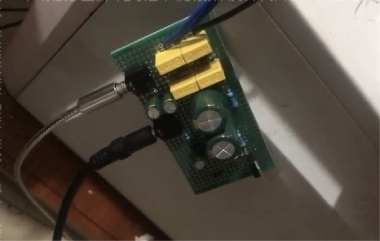
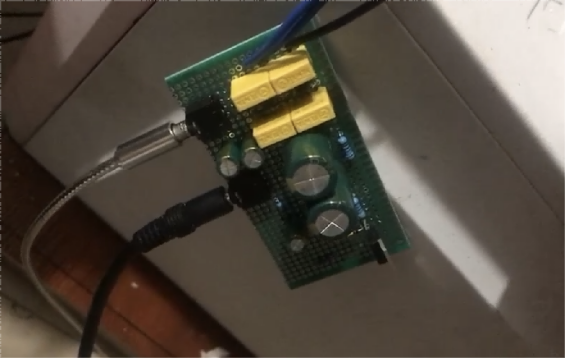
Below is a picture of the board—you can use a perfboard, and the results are pretty good (finished board size: 44mm x 80mm).
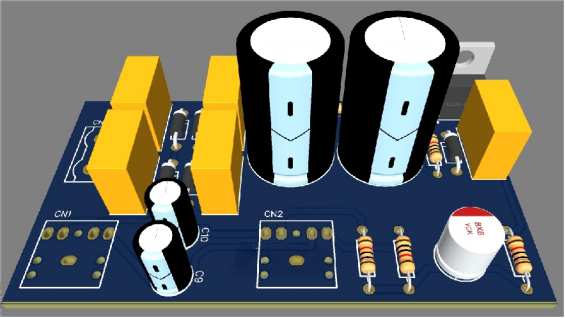
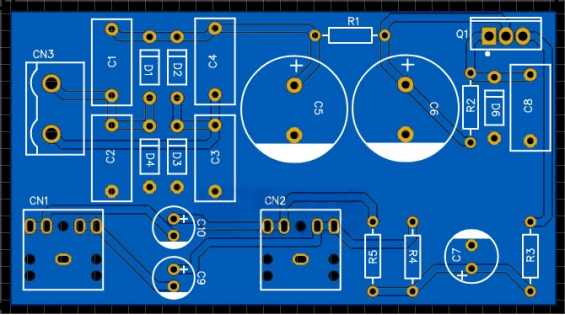
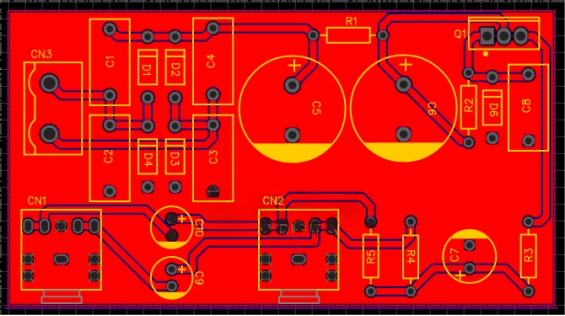
Of course, there's no switch here yet. If you need one, you can break the circuit in front of R3 and add a self-locking switch.
The end.


