
NVIDIA Q4 Profit Jumps 94%, Data Center Hits Record


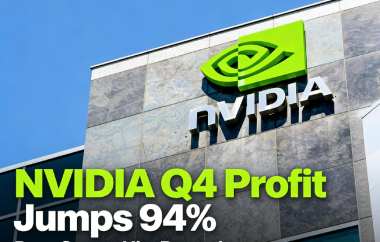
NVIDIA has reported record-breaking financial results for its fourth quarter and full fiscal year ending January 25, 2026, underscoring how rapidly demand for accelerated computing and AI infrastructure continues to expand. The company's data center segment once again led performance, while its outlook for the next quarter exceeded market expectations, reinforcing confidence in sustained AI-driven growth.
For the fourth quarter of fiscal 2026, NVIDIA generated $68.1 billion in revenue, up 73% year-over-year and 20% sequentially, surpassing analyst forecasts. GAAP net income reached $42.96 billion, nearly doubling from a year earlier, with earnings per share of $1.76. Gross margin improved to 75.0%, reflecting strong profitability across its AI computing portfolio. On a non-GAAP basis, net income was $39.55 billion and gross margin reached 75.2%, further highlighting the efficiency of its current product cycle.
The data center business remained the primary growth engine, delivering a record $62.3 billion in quarterly revenue, up 75% year-over-year. This surge was driven by the transition to accelerated computing platforms and large-scale AI deployments. Hyperscale cloud providers continued to represent the largest customer group, contributing more than half of data center revenue. Networking products alone generated $10.98 billion, rising sharply as NVLink interconnect technology and Spectrum-X Ethernet switching solutions gained broader adoption, including new deployments from major technology firms such as Meta Platforms.
Gaming and AI PC revenue reached $3.7 billion, increasing 47% year-over-year, supported by strong demand for the Blackwell architecture. Sequentially, revenue declined 13% following seasonal strength in the previous quarter, as channel inventory normalized after holiday demand. Meanwhile, professional visualization revenue rose significantly to $1.3 billion, driven by increased adoption of Blackwell-based platforms in design, simulation, and AI-assisted workflows. Automotive and robotics revenue reached $604 million, reflecting steady adoption of NVIDIA’s autonomous driving and embedded AI systems.
For the full fiscal year 2026, NVIDIA reported total revenue of $215.9 billion, representing 65% growth compared with the previous year. GAAP net income reached $120.07 billion, with earnings per share of $4.90. Gross margin remained strong above 71%, despite slight pressure from scaling production and expanding infrastructure investments. The company returned $41.1 billion to shareholders through share repurchases and dividends, with $58.5 billion remaining under its current buyback authorization.
Looking ahead, NVIDIA expects fiscal 2027 first-quarter revenue of approximately $78 billion, well above market estimates. Notably, this forecast does not assume any data center computing revenue from mainland China. The company also expects gross margins to remain around 75%, indicating continued strong demand for its AI platforms.
On the technology front, NVIDIA highlighted its next-generation Vera Rubin compute module, designed with a modular architecture to improve resilience and serviceability compared with Blackwell. The new platform is expected to deliver up to ten times better performance per watt, addressing growing power constraints in modern data centers. It is also optimized for mixture-of-experts AI models, potentially reducing inference costs per token by up to tenfold while improving efficiency.
NVIDIA also confirmed that its Grace Blackwell systems are now widely deployed across major cloud service providers and hyperscale data centers, with NVLink scale-up architecture serving as a foundation for large-scale AI training and inference. The company is expanding its supply chain footprint beyond Asia into the United States and Latin America to strengthen manufacturing resilience and support future demand.
In addition, NVIDIA reported strong internal adoption of advanced AI coding models trained on its Grace Blackwell and NBL72 systems. These models are already being used extensively by engineering teams to accelerate software development and automation workflows, highlighting the growing practical impact of agent-based AI. CEO Jensen Huang noted that agentic AI is reaching a key inflection point, with organizations rapidly scaling both training and inference infrastructure.
Beyond cloud AI, NVIDIA emphasized continued growth in physical AI and edge computing. Its Jetson embedded platforms are seeing expanding use in robotics, industrial automation, and autonomous systems. Combined with its progress in AI training, inference, and integrated AI infrastructure, NVIDIA is strengthening its position as a core technology provider powering the next phase of AI deployment across cloud, enterprise, and real-world applications.


