
What Is a Photodiode? Working Principles, Types, and Materials


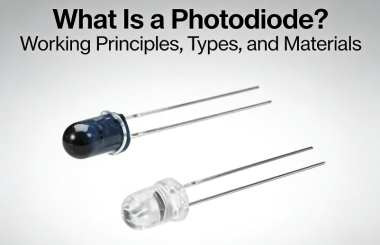
Against the backdrop of rapid growth in optical communications, sensors, and consumer electronics, photodiodes have become indispensable core components in the electronic components industry. They are capable of directly converting optical signals into electrical signals, serving as a critical interface for “optical-to-electrical” conversion. With the rise of 5G communications, data centers, autonomous driving, and industrial automation, the demand for high-sensitivity and high-speed photodetectors continues to grow, further highlighting the importance of photodiodes.
I. Definition of Photodiodes
A photodiode is a semiconductor device based on a PN junction structure that functions as a photodetector. Its primary role is to absorb incident photons and convert them into electrical current. When the energy of incoming photons exceeds the bandgap of the semiconductor material, electron-hole pairs are generated within the device, producing a photocurrent that can be detected by external circuits. Based on structure and operation, photodiodes are mainly classified into PIN photodiodes and avalanche photodiodes (APDs).
II. Working Principle
The operation of a photodiode is based on the photoelectric effect. When photons strike the PN junction region and their energy exceeds the material bandgap, electron-hole pairs are generated. Under a reverse bias voltage, a strong electric field is formed across the junction, rapidly separating these charge carriers and driving them toward the electrodes, thereby generating a photocurrent. This current is then amplified and processed by subsequent circuitry to produce a usable electrical signal.
In a PIN photodiode, an intrinsic (I) layer is introduced to enlarge the light absorption region, increasing the probability of photon-generated carriers and improving detection efficiency. In contrast, in an avalanche photodiode (APD), the initial electrons are accelerated by a strong electric field and create additional electron-hole pairs through impact ionization, resulting in an avalanche multiplication effect. This significantly enhances signal gain but also introduces noise and randomness.
III. Key Features and Advantages
Photodiodes offer several advantages, including fast response speed, high sensitivity, compact size, and ease of integration. In high-speed communication systems, their nanosecond or even picosecond response times enable them to handle high-frequency signals effectively. Additionally, their linear output characteristics ensure stable and reliable signal processing.
Compared to traditional photoelectric conversion devices, PIN photodiodes feature a simple structure, lower cost, and lower noise, making them suitable for most general-purpose applications. APDs, on the other hand, provide internal gain, making them ideal for low-light detection and long-distance communication. Furthermore, different semiconductor materials allow operation across various wavelength ranges. For example, silicon (Si) is suitable for around 800 nm, germanium (Ge) for approximately 1400 nm, and indium gallium arsenide (InGaAs) is widely used in 1500 nm optical communication systems.
IV. Applications
Photodiodes play a critical role across multiple sectors of the electronics industry. In optical communication systems, they serve as key components in receivers, converting optical signals in fiber into electrical signals. In data centers and high-speed networks, high-performance PIN and APD devices are widely used in optical modules and transceivers.
In consumer electronics, photodiodes are used for ambient light sensing, infrared remote control, and wearable devices, enabling features such as automatic brightness adjustment and biometric sensing. In industrial and automotive fields, applications include laser ranging, LiDAR systems for autonomous driving, and optical sensing in industrial automation. Additionally, photodiodes are widely applied in medical devices, renewable energy systems, and security monitoring.
V. Conclusion
In summary, photodiodes are essential components for optical-to-electrical conversion and play an irreplaceable role in modern electronic systems. As emerging industries such as artificial intelligence, data centers, and smart vehicles continue to evolve, demand for high-performance photodetectors will keep rising. With ongoing advancements in materials and packaging technologies, photodiodes are expected to achieve higher speeds, greater sensitivity, and broader wavelength coverage, driving further innovation in the electronic components industry.


