
How to Identify Color-Coded Resistors?


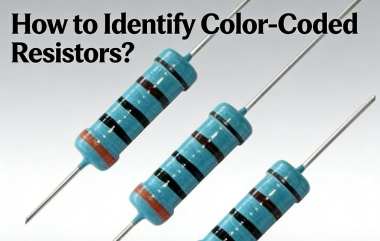
In the field of electronic components, resistors are among the most fundamental and widely used elements, and accurate identification of their resistance value is critical to circuit performance and stability. In addition to common measurement methods such as the volt-ampere method (based on Ohm’s Law, R = U/I), the color-coded resistor identification method is widely used in practical engineering due to its convenience and the fact that it does not require measurement instruments. For electronic engineers, hardware developers, and maintenance technicians, mastering this method is a basic and essential skill.
What Is a Color-Coded Resistor
A color-coded resistor is a type of resistor that uses colored bands on its surface to indicate its resistance value and tolerance. It is commonly used in carbon film resistors, metal film resistors, metal oxide film resistors, and wirewound resistors. The basic units include ohms (Ω), kilo-ohms (kΩ), and mega-ohms (MΩ), where 1 MΩ equals 1,000 kΩ or 1,000,000 Ω. This color band design allows the resistance value to be easily read regardless of installation direction, greatly improving efficiency in engineering applications.
Working Principle and Identification Method
The identification of color-coded resistors is based on the relationship between colors, numerical values, and multipliers. The most common types are four-band, five-band, and six-band resistors.
For four-band resistors, the bands from left to right represent: the first significant digit, the second significant digit, the multiplier (power of 10), and the tolerance. For example, red (2), violet (7), brown (×10), and gold (±5%) indicate a resistance value of 27 × 10 = 270 Ω with a tolerance of ±5%.
Five-band resistors add an extra significant digit. The first three bands represent digits, the fourth band is the multiplier, and the fifth band indicates tolerance, making them suitable for higher-precision applications. For example, red, red, black, black, and brown represent 220 Ω with a tolerance of ±1%.
Six-band resistors include an additional sixth band to indicate the temperature coefficient and are typically used in high-reliability or specialized electronic applications.
Characteristics and Advantages
Color-coded resistors feature a simple structure, low cost, and high stability, making them indispensable in traditional electronic circuits. Their key advantage lies in the ability to quickly identify resistance values without using measurement tools, which is especially beneficial in mass production, field maintenance, and educational environments. In addition, the color coding system is standardized and globally recognized, facilitating international engineering collaboration. Different colors also represent tolerance levels, allowing engineers to quickly assess resistor accuracy and optimize circuit design.
Typical Applications
Color-coded resistors are widely used in various electronic devices, including consumer electronics, industrial control systems, power modules, communication equipment, and automotive electronics. In early electronic products, due to their larger size, color-coded resistors were standard components. Even in today’s highly integrated systems, they still play an important role in discrete circuits, testing environments, and educational experiments. High-precision five-band and six-band resistors are commonly used in aerospace, military equipment, and precision instruments, where strict requirements for stability and temperature performance are essential.
Conclusion
As a fundamental concept in electronics, the color-coded resistor identification method remains highly important due to its simplicity and efficiency. Although modern electronic design is increasingly moving toward miniaturization and digitalization, color-coded resistors are still irreplaceable in certain applications. Mastering their identification rules and usage not only improves engineering efficiency but also provides a solid foundation for understanding electronic circuit design.


