
How Does a Photoelectric Sensor Work?


Against the backdrop of rapid advancements in modern electronics and intelligent manufacturing, sensors have become fundamental components for information acquisition and system control. Among them, photoelectric sensors (light sensors) are widely used in industrial automation, consumer electronics, and smart devices due to their non-contact measurement, fast response, and high reliability. With the growing adoption of the Internet of Things (IoT) and artificial intelligence (AI), demand for high-precision optical detection continues to rise, making photoelectric sensors one of the most important components in the electronic devices industry.
What Is a Photoelectric Sensor
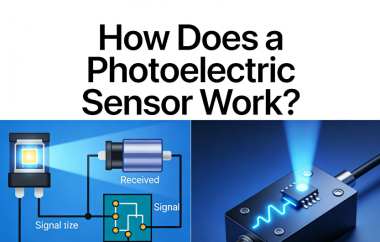
A photoelectric sensor is an electronic device that converts light signals into electrical signals. It operates based on the photoelectric effect to detect light intensity, spectrum, or variations in light. Typically, it consists of a sensing element, a conversion component, a signal conditioning circuit, and a power supply module. The sensing element detects light, the conversion component transforms it into electrical parameters, and the signal is then processed into a standardized output for control or data acquisition. Common types include photoresistors, photodiodes, phototransistors, CCD/CMOS image sensors, as well as infrared and ultraviolet sensors.
Working Principle
The core working mechanism of a photoelectric sensor is based on the semiconductor photoelectric effect. When light strikes the surface of a photosensitive material, photon energy excites electrons, altering the material’s conductivity. Taking a photoresistor as an example, its resistance is high (dark resistance) with minimal current flow in the absence of light. When exposed to light, the number of charge carriers increases, causing the resistance to drop significantly (light resistance) and the current to rise. This variation allows the circuit to convert changes in light intensity into voltage or current signals, which can then be processed through analog-to-digital conversion. In general, stronger الضوء results in stronger output signals, enabling precise light detection and control.
Applications
Photoelectric sensors are widely applied across various electronic and industrial scenarios. In consumer electronics, they are used for automatic brightness adjustment in smartphones, camera exposure control, and display sensing. In industrial automation, they support production line inspection, position detection, and safety monitoring. In smart home systems, they enable automatic lighting control, ambient light sensing, and energy management. In automotive electronics, they are used for automatic headlight control and environmental light detection. Additionally, in medical equipment, security systems, and scientific instruments, photoelectric sensors play a critical role, especially in high-precision measurement and non-contact detection applications.
Conclusion
Overall, as a key sensing component in electronic systems, photoelectric sensors continue to evolve alongside trends in intelligence and digitalization. From basic light detection to advanced image sensing, their technological capabilities and application scope are constantly expanding. Looking ahead, with the development of AI, autonomous driving, and IoT, the demand for highly sensitive and stable photoelectric sensing solutions will continue to grow, further strengthening their importance in the electronic components industry.


