
TSMC Q1 Profit +58%, 2nm in Production


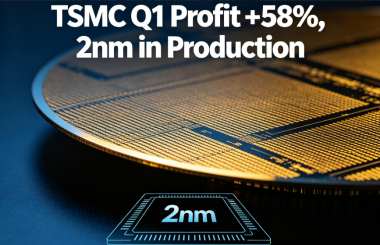
According to TSMC, the world’s leading pure-play foundry reported record-breaking financial results for the first quarter of 2026, with both revenue and profit exceeding market expectations. The strong performance was primarily driven by sustained demand for artificial intelligence (AI) applications, prompting the company to raise its full-year revenue outlook and maintain aggressive investment in advanced technologies.
In Q1 2026, TSMC posted consolidated revenue of approximately NT$1.13 trillion, up 35.1% year-over-year and 8.4% quarter-over-quarter. Net profit surged 58.3% year-over-year to NT$572.48 billion, also reaching a record high. On a U.S. dollar basis, revenue totaled $35.9 billion, representing a 40.6% annual increase. The company achieved a gross margin of 66.2%, operating margin of 58.1%, and net profit margin of 50.5%, underscoring its strong profitability.
Advanced process technologies continued to dominate TSMC’s revenue mix. The 3nm node contributed 25% of total wafer revenue, while 5nm and 7nm accounted for 36% and 13%, respectively. Overall, advanced nodes (7nm and below) made up 74% of total wafer sales. By application, high-performance computing (HPC) led growth with a 20% sequential increase, followed by IoT and consumer electronics.
Looking ahead, TSMC expects second-quarter revenue to range between $39 billion and $40.2 billion, potentially setting another record. The company also raised its full-year outlook, projecting more than 30% revenue growth in U.S. dollar terms, compared to its earlier estimate of “nearly 30%.”
Capital expenditure guidance remains between $52 billion and $56 billion for 2026, with spending likely to trend toward the upper end. The investment will support capacity expansion and technology development to capture long-term opportunities in AI, 5G, and high-performance computing.
TSMC emphasized that AI-related demand remains “extremely strong,” driven by a shift from traditional query-based generative AI to more advanced agentic AI models, which require significantly higher computing power and token processing. This transition continues to fuel demand for leading-edge semiconductor technologies.
On pricing strategy, Chairman and CEO C. C. Wei stated that the company will not pursue aggressive price increases despite strong demand. Instead, TSMC aims to maintain long-term partnerships with customers and support their success while scaling its own value.
In terms of technology progress, TSMC confirmed that its 2nm (N2) process has entered high-volume manufacturing ahead of schedule, with solid yield performance. The company is also expanding 3nm (N3) capacity globally—breaking past practice—to meet surging demand from AI, smartphones, and data center applications.
Additionally, TSMC unveiled progress on its next-generation A14 process, which is expected to deliver 10–15% performance improvement at the same power or 25–30% power reduction at the same performance, along with increased chip density. Mass production is targeted for 2028.
Global expansion efforts are ongoing, including new fabs in Taiwan, the United States, and Japan. The company is also optimizing mature-node capacity and reallocating resources to support advanced nodes. In advanced packaging, TSMC continues to scale CoWoS capacity and is developing next-generation CoPoS technology to address growing demand for AI chip integration.
Regarding competition from Intel and initiatives such as Elon Musk’s Terafab project, TSMC acknowledged the competitive landscape but emphasized that semiconductor manufacturing requires long-term investment, advanced technology, and customer trust, with “no shortcuts” to scaling capacity.
Finally, the company addressed geopolitical risks, noting that raw material and energy supply remain stable. Through diversified sourcing strategies and inventory management, TSMC expects no near-term disruption from global uncertainties, including tensions in the Middle East.
Overall, TSMC’s latest results highlight its continued leadership in advanced semiconductor manufacturing, reinforced by strong AI-driven demand and sustained investment in next-generation technologies.


