
What Is the Difference Between Compressed Air Energy Storage and Supercapacitors?


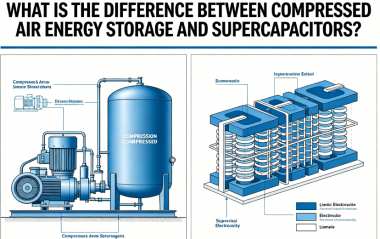
In the electronic components industry, Compressed Air Energy Storage (CAES) is a mechanical energy storage technology designed for large-scale power systems, while Supercapacitors are typical electrochemical energy storage devices widely used in electronic equipment and high-power transient energy management. With the development of smart grids, electric vehicles, and industrial electronic systems, these two technologies play complementary roles in “long-duration large-capacity energy storage” and “short-duration high-power output,” respectively, becoming important components of modern energy and electronic system design.
I. What are Compressed Air Energy Storage and Supercapacitors?
Compressed Air Energy Storage is a method of energy storage in which air is compressed and stored in underground caverns or high-pressure vessels during periods of low electricity demand or low electricity prices, and then released during peak demand to drive turbines and generate electricity.
A supercapacitor is an energy storage device positioned between traditional capacitors and batteries. It stores electrical energy through the formation of an electric double-layer structure at the electrode–electrolyte interface or through pseudocapacitance effects, enabling rapid charge and discharge processes.
II. Working Principles of Compressed Air Energy Storage and Supercapacitors
The core of CAES lies in the process of “mechanical conversion – gas storage – expansion power generation.” During the charging phase, electrical energy drives compressors to compress air for storage; during discharge, the high-pressure air is released to drive turbines connected to generators, producing electricity.
Supercapacitors operate based on the mechanism of charge separation at the electrode surface. During charging, electrons and ions accumulate at the electrode–electrolyte interface to form an electric field; during discharge, the stored charge is rapidly released, delivering energy output with almost no complex chemical reactions involved.
III. Energy Storage Mechanisms of CAES and Supercapacitors
CAES is a typical physical energy storage technology, where energy is stored in the form of compressed air, relying fundamentally on the potential energy changes associated with gas compression and expansion.
The energy storage of supercapacitors is mainly based on physical adsorption and rapid ion arrangement at the electrochemical interface, including electric double-layer capacitance and pseudocapacitance mechanisms, giving them significantly higher energy density than conventional capacitors.
IV. Efficiency, Cost, and Lifespan of CAES and Supercapacitors
The overall efficiency of CAES systems is influenced by compression, thermal management, and expansion processes. Conventional systems typically achieve efficiencies of 40% to 55%, while advanced adiabatic CAES technologies can significantly improve energy recovery efficiency. Although CAES requires high initial construction costs and depends on specific geological conditions, it offers lower cost per unit of stored energy in large-scale applications.
Supercapacitors offer relatively high energy conversion efficiency, typically ranging from 80% to 90%, with minimal energy loss during charge and discharge. They also feature extremely long cycle life, reaching hundreds of thousands to millions of cycles, although their cost per unit of energy remains higher than that of some battery technologies.
V. Environmental Impact of CAES and Supercapacitors
CAES systems produce virtually no direct emissions during operation. However, if fossil fuel-based auxiliary heating is used, it may result in certain carbon emissions. Overall, CAES is considered environmentally friendly, especially when integrated with renewable energy systems.
Supercapacitors have relatively low environmental impact, as they do not involve toxic heavy metals or complex chemical by-products, and their materials are highly recyclable, making them environmentally favorable in electronic waste management.
VI. Application Fields of CAES and Supercapacitors
CAES is mainly used in grid-level energy storage systems, including peak shaving, load balancing, renewable energy integration, and large-scale power system frequency regulation. It is suitable for long-duration, large-capacity energy management requirements.
Supercapacitors are widely applied in electronic and power electronic systems, such as industrial power transient compensation, start-stop systems in electric vehicles, regenerative braking energy recovery, UPS power supplies, and high-power pulse devices. Their key advantage lies in millisecond-level rapid response capability.
VII. Conclusion
Compressed Air Energy Storage and Supercapacitors represent important directions in macro-scale energy systems and micro-scale electronic component technologies, respectively. The former is suitable for large-scale, long-duration energy dispatch and grid stability support, while the latter excels in high-frequency, high-power-density electronic applications. In the future development of energy internet and intelligent electronic systems, they are not competing technologies but complementary components jointly forming a multi-layer energy storage architecture.


