
What Is the Difference Between a Diode and a Transistor?


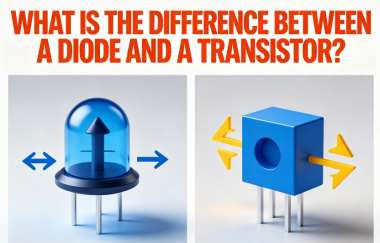
During the selection of electronic components and the process of circuit design, diodes and transistors are the most basic and also the most easily confused types of semiconductor devices. Whether in rectifier circuits, switching power supplies, or signal amplification systems, both play irreplaceable roles. However, many engineers, procurement personnel, and even electronics enthusiasts still have blurred understandings of their essential differences, functional boundaries, and control methods. This article systematically analyzes the core differences between diodes and transistors from three dimensions—structure, function, and control—to help readers make accurate judgments in practical applications.
I. What Are Diodes and Transistors?
A diode is a two-electrode semiconductor device formed by combining P-type and N-type semiconductors. Its two electrodes are the anode (positive) and cathode (negative). Since it contains only a single PN junction, the diode is a passive component and does not have current amplification capability. A transistor is a three-electrode device composed of three semiconductor regions, typically in NPN or PNP configurations, formed by two back-to-back PN junctions. The three electrodes are the emitter, base, and collector. The transistor is an active component capable of current or voltage amplification control. By definition, the core function of a diode is “unidirectional conduction,” while the core function of a transistor is “current controlling current.”
II. Functional Differences Between Diodes and Transistors
The main functions of a diode derive from its unidirectional conductivity, including rectification (converting AC to pulsating DC), reverse voltage protection (preventing damage from reverse power connection), freewheeling (protecting switching components from inductive kickback), voltage regulation (Zener diodes), light emission (LEDs), and photodetection. In contrast, transistors offer richer and more complex functions. Besides being used as electronic switches, the most typical application of a transistor is signal amplification—for example, amplifying a weak microphone signal to drive a speaker. Additionally, transistors can form oscillators, constant current sources, and voltage regulators when combined with other components. In short, diodes excel at “on/off control” and “direction limiting,” while transistors excel at “linear amplification” and “controllable switching.”
III. Differences in Control Methods Between Diodes and Transistors
In terms of control methods, diodes and transistors are fundamentally different. The operating state of a diode is entirely determined by the polarity and magnitude of the applied voltage: when the anode voltage is higher than the cathode voltage and exceeds the PN junction’s turn-on threshold (approx. 0.6–0.7V for silicon, 0.2–0.3V for germanium), the diode is forward-biased and conducts; conversely, when the cathode voltage is higher than the anode voltage, the diode is reverse-biased and blocks current. A diode has no independent control terminal—its conduction depends solely on the voltage conditions imposed by the external circuit.
A transistor, however, has an independent control terminal—the base. In a common-emitter amplifier circuit, a small change in base current can directly control a much larger change in current between the collector and emitter, with a current amplification factor (β value) typically ranging from tens to hundreds. When the base current is zero or negative, the transistor operates in the cut-off region, equivalent to an open switch. When the base current is large enough to drive the transistor into saturation, the collector-emitter path behaves like a closed switch. Therefore, a transistor can be seen as a “current-controlled current source or switch,” whereas a diode can only passively respond to external voltage.
IV. Conclusion
Although diodes and transistors belong to the same semiconductor device family, they have essential differences in structure, function, and control. A diode consists of a single PN junction and two electrodes, mainly providing unidirectional conduction functions such as rectification, protection, and freewheeling, and its operating state is passively determined by external voltage. A transistor consists of two PN junctions and three electrodes, capable not only of electronic switching but also of linear amplification of current or voltage, with the core feature being active control of collector-emitter current via base current. In practical circuit design, if the goal is simply to limit current direction or provide rectification protection, a diode should be prioritized. If signal amplification or controlled high-current switching is needed, a transistor must be used. Understanding and remembering these differences is the foundation for improving electronic circuit design skills and avoiding selection errors.


