
What Is the Working Principle and Structure of a Diode?


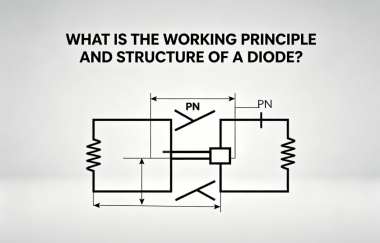
In the electronics components industry, the diode is one of the most fundamental and widely used semiconductor devices. It exists in almost all electronic equipment, playing indispensable roles in power rectification, circuit protection, and signal processing. With the rapid development of consumer electronics, automotive electronics, and industrial control systems, the performance and reliability of diodes have become critical factors in circuit design. For electronic engineers and procurement personnel, a deep understanding of the basic characteristics of diodes helps achieve more rational selection and optimized design across different application scenarios.
I. What is a Diode?
A diode is a semiconductor device with “unidirectional conductivity.” Its core structure consists of a PN junction and two electrodes. When the applied voltage is in the correct direction, current can flow smoothly; when the voltage is reversed, the current is almost completely blocked. Therefore, diodes are commonly used in circuits for rectification, freewheeling, voltage regulation, and signal clamping.
From a physical perspective, the operation of a diode relies on the potential barrier formed by the PN junction between P-type and N-type semiconductor regions, which determines its fundamental electrical characteristics.
II. Working Principle of a Diode
The working principle of a diode is based on the carrier transport mechanism of the PN junction. When no external voltage is applied, a depletion region is formed within the PN junction, and electrons and holes reach a dynamic equilibrium at the junction interface.
When the diode is forward biased (P-side connected to positive terminal and N-side to negative terminal), the external electric field reduces the potential barrier, allowing electrons to diffuse from the N region to the P region while holes move from the P region to the N region. Carrier recombination increases, current rises rapidly, and the diode becomes conductive.
When the diode is reverse biased, the external electric field increases the barrier height, widening the depletion region. Carriers find it difficult to cross the PN junction, resulting in only a very small reverse leakage current, and the diode remains in a cutoff state. This behavior forms the basis of the diode’s “unidirectional conductivity.”
III. Structure and Parameters of a Diode
1. Structural Types
Depending on manufacturing processes and application requirements, diodes are mainly classified into the following types:
Point-contact diode
The PN junction area is small, with low junction capacitance. It is suitable for high-frequency small-signal circuits but has limited current handling capability.
Junction-type (surface-contact) diode
It has a larger PN junction area and can handle higher current, making it commonly used in rectifier and power circuits.
Planar diode
Manufactured using diffusion or epitaxial processes, it offers good consistency and reliability and is the most widely used type in modern industry.
In addition, based on functionality, diodes can be further categorized into rectifier diodes, Zener diodes (voltage regulator diodes), Schottky diodes, and light-emitting diodes (LEDs).
2. Key Electrical Parameters
The selection of diode performance mainly depends on the following key parameters:
Maximum Reverse Voltage (VRRM): Indicates the maximum reverse voltage the device can withstand; exceeding this value may cause breakdown.
Maximum Forward Current (IF): The maximum current the device can conduct under normal operating conditions.
Forward Voltage Drop (VF): The voltage drop across the diode during conduction, which affects power consumption.
Reverse Leakage Current (IR): A small current generated under reverse bias, affecting device stability.
Reverse Recovery Time (trr): The time required for the diode to switch from conducting to blocking state, determining high-frequency performance.
Junction Capacitance (Cj): Affects high-frequency response and is particularly important in RF circuits.
These parameters directly determine the applicability of diodes in different scenarios, such as high-speed switching circuits, rectifier power supplies, or high-frequency communication systems.
IV. Conclusion
As one of the most fundamental semiconductor devices in electronic circuits, the diode’s unidirectional conductivity forms a basic functional building block of modern electronic systems. From the physical mechanism of the PN junction to different structural types and key electrical parameters, each characteristic directly affects its performance in practical applications.
In engineering practice, proper selection of diode models not only influences circuit efficiency and stability but also impacts system safety and lifespan. Therefore, a thorough understanding of diode principles and parameters is essential for electronic circuit design and component selection.


