
What Are the Working Principles, Characteristics, and Testing Methods of Phototransistors?


In the electronic components industry, optoelectronic conversion devices are key fundamental components for realizing the mutual conversion between optical signals and electrical signals. Among them, phototransistors are widely used in industrial control, optoelectronic detection, communication systems, and intelligent sensing equipment due to their high sensitivity and strong amplification capability. With the rapid development of automation and intelligent electronic products, the importance of phototransistors in optoelectronic switches, optocoupler circuits, and signal detection applications continues to increase, making them an indispensable basic component in electronic engineering design.
I. What is a Phototransistor?
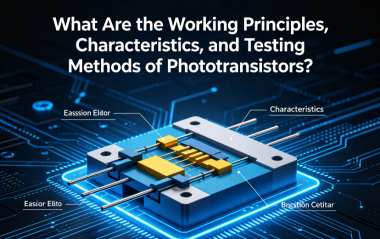
A phototransistor is a light-sensitive semiconductor device based on the photoelectric effect. In essence, it is a transistor structure that is sensitive to light, typically composed of an emitter, base, and collector. Unlike ordinary transistors, phototransistors use light exposure to generate charge carriers, thereby achieving current control and amplification.
When light is incident on the base region or photosensitive area of the device, the semiconductor material absorbs photon energy and generates electron-hole pairs. These carriers move directionally under the internal electric field, resulting in a significant change in output current and enabling the conversion from optical signals to electrical signals.
II. Working Principle of Phototransistors
The working principle of a phototransistor is based on the combination of the photoelectric effect and the current amplification mechanism of a transistor. When incident light illuminates the base region of the device, and the photon energy is greater than the bandgap of the semiconductor material, electron-hole pairs are generated.
These carriers are separated under the built-in electric field, increasing the base current. Since the transistor structure itself has current amplification capability, the collector current is significantly amplified. In other words, a phototransistor not only performs optoelectronic conversion but also amplifies the signal through transistor characteristics, which is a key difference from photodiodes.
Under typical operating conditions, phototransistors usually operate in a reverse bias state, which improves response speed and output stability, making them more suitable for low-light detection and high-speed signal acquisition applications.
III. Characteristics and Advantages of Phototransistors
Phototransistors offer several significant advantages in electronic circuit applications, which make them an important type of optoelectronic device.
First, they have high sensitivity. Due to the internal current amplification mechanism, even weak light can produce a noticeable change in current, making them suitable for low-light detection environments.
Second, they have fast response speed, which can meet most medium- to high-speed signal detection requirements. They perform reliably in optoelectronic switches and encoder systems.
Third, they feature a simple structure and low cost, making them suitable for mass production and widely used in consumer electronics and industrial control products.
In addition, phototransistors have good environmental adaptability and can maintain stable performance within a certain temperature range, providing high reliability in complex industrial environments.
Finally, they offer flexible application methods and can be used in optoelectronic switches, current amplification circuits, and optical signal detection modules, making them a core component in various optoelectronic systems.
IV. Testing Methods for Phototransistors
In practical applications and production testing, the performance evaluation of phototransistors mainly includes photocurrent testing and dark resistance testing.
Photocurrent testing is performed by illuminating the photosensitive area of the device with a standard light source and measuring the resulting output current changes. The stronger the light intensity, the higher the photocurrent generated. This method is used to evaluate the device’s sensitivity and response capability.
Dark resistance testing involves measuring the resistance value of the device in a dark environment, then re-measuring it under illumination and comparing the results. The variation in resistance is used to determine the photoconductive characteristics and consistency of the device.
In industrial testing, response time testing and linearity testing may also be included to evaluate dynamic performance and stability in real circuit applications, ensuring that the device meets application requirements.
V. Conclusion
As a typical optoelectronic conversion and signal amplification device, the phototransistor plays an important role in modern electronic systems. Its composite working principle based on the photoelectric effect and transistor amplification mechanism provides significant advantages in sensitivity, response speed, and application flexibility.
With the development of intelligent sensing and automation technologies, phototransistors will continue to play a key role in industrial detection, optoelectronic control, smart devices, and communication systems. Proper selection and standardized testing are essential to ensure stable performance and reliable system operation.


