
What Is a Crystal Transistor and What Types Does It Have?


In the electronics components industry, diodes and transistors are among the most fundamental and important semiconductor devices. They are widely used in amplification, switching, oscillation, and signal processing circuit structures. Among them, the crystal transistor plays a key role as a core active device in modern electronic equipment. From consumer electronics to industrial control systems, its presence is indispensable. This article systematically introduces the basic knowledge of crystal transistors from aspects such as definition, structure, types, and applications.
I. What is a Crystal Transistor?
A crystal transistor, also known as a semiconductor transistor or Bipolar Junction Transistor (BJT), is a semiconductor device that uses minority carriers to control current amplification. It is composed of two different types of semiconductor materials and forms two PN junctions, thus providing current amplification and switching capabilities.
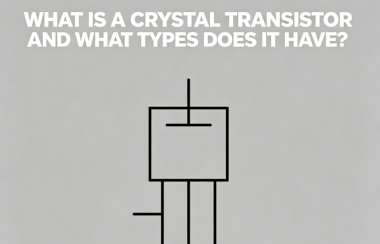
Structurally, a crystal transistor has three terminals: the base (B), emitter (E), and collector (C). Internally, it consists of an emitter junction and a collector junction, with different regions corresponding to the emitter region, base region, and collector region. Depending on the semiconductor material structure, crystal transistors can be classified into NPN type and PNP type.
An NPN transistor is formed by sandwiching a P-type semiconductor between two N-type semiconductors, while a PNP transistor is formed by sandwiching an N-type semiconductor between two P-type semiconductors. This structure determines the direction of current flow and control characteristics, which are critical factors in circuit design.
II. Main Types of Crystal Transistors
Crystal transistors come in a wide variety and can be classified based on material, application, power, frequency, manufacturing process, and packaging, to meet the needs of different electronic systems.
By material and polarity, they mainly include silicon-based NPN and PNP transistors, as well as earlier germanium transistors. Silicon transistors are the most widely used today due to their high stability and excellent temperature characteristics.
By application, they can be divided into high-frequency amplifying transistors, intermediate-frequency amplifying transistors, low-frequency amplifying transistors, low-noise transistors, phototransistors, switching transistors, high-voltage transistors, and Darlington transistors. Among them, Darlington transistors are widely used in driver circuits due to their extremely high current gain.
By power level, they are classified into small-power, medium-power, and high-power transistors, suitable for signal processing, power driving, and power amplification respectively.
By operating frequency, they include low-frequency, high-frequency, and ultra-high-frequency transistors, which are widely used in audio amplification, RF communication, and high-speed digital circuits.
By manufacturing process, common types include planar, alloy, and diffusion transistors. Different processes affect device performance and reliability.
By packaging type, they include metal, glass, ceramic, and plastic packages. Among them, plastic packaging is the most widely used due to its low cost and compact size.
III. Typical Application Areas of Crystal Transistors
Due to their current amplification and switching capabilities, crystal transistors are widely used in electronic systems and are indispensable basic components in modern electronic design.
In analog circuits, crystal transistors are commonly used for signal amplification, such as audio power amplifiers, preamplifier circuits, and sensor signal conditioning circuits. They effectively enhance weak signals and ensure proper operation of subsequent stages.
In digital and switching circuits, crystal transistors serve as electronic switches and are widely used in relay driving, power control, motor driving, and LED control applications.
In communication equipment, high-frequency transistors are used for RF amplification and signal modulation, making them key components in wireless communication modules.
In industrial control systems, crystal transistors are widely used in automation equipment, power management systems, and PLC control systems for signal isolation and power driving.
In consumer electronics such as televisions, audio systems, and mobile phone chargers, crystal transistors also play a central role in control and signal amplification functions.
IV. Conclusion
As a fundamental core device in the field of electronic components, the crystal transistor features a simple structure but powerful functionality. By controlling the base current, it can precisely regulate a larger current, making it irreplaceable in amplification and switching circuits.
With the development of electronic technology, crystal transistors continue to evolve toward higher frequency, miniaturization, and greater reliability. Their application scope is also expanding continuously. From basic electronic devices to advanced industrial systems, crystal transistors remain an essential component in electronic engineering design.


