
Samsung Labor Talks Break Down, DDR4 Prices Jump 20%


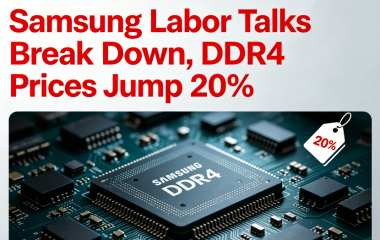
According to recent market intelligence reports, labor negotiations at Samsung Electronics have broken down, raising the risk of a large-scale strike that is beginning to influence global memory market sentiment. At the same time, spot pricing signals emerging from Shenzhen’s Huaqiangbei Electronics Market indicate a potential shift from recent weakness to renewed upward momentum across key DRAM categories, with signs of restocking-driven demand returning to the channel.
DDR4 pricing has shown a sharp rebound. Latest quotations from China-based memory market tracker China Flash Market show that DDR4 8Gb 3200MHz spot prices have climbed to approximately $18 this week, representing a 20% week-on-week increase. This marks one of the most significant short-term recoveries in recent months and suggests tightening near-term supply-demand balance after a prolonged downtrend.
DDR4 remains a core product category for major Taiwan-based memory manufacturers, including widely shipped 8Gb-class components used across consumer electronics and industrial applications. The latest price strength emerging from the Huaqiangbei market is being closely watched as an early indicator of broader contract pricing stabilization.
In parallel, NAND Flash wafer pricing has largely stabilized after previous declines. Key products such as 1Tb QLC, 1Tb TLC, and 512Gb TLC have all moved into a flat pricing range, signaling that downward price pressure in the NAND segment is easing.
On the enterprise side, DDR5 server memory continues to strengthen. DDR5 RDIMM 64GB modules are now priced around $1,350, reflecting an 11% month-on-month increase, while 96GB modules have also risen by approximately 10%. The continued upward trend highlights sustained demand from AI servers, high-performance computing systems, and bandwidth-intensive workloads, particularly driven by accelerating artificial intelligence infrastructure deployment.
Industry participants note that the combination of strong AI server demand, expanding high-bandwidth memory (HBM) requirements, and tightening supply conditions is already supporting memory pricing. The added uncertainty surrounding potential production disruptions linked to Samsung’s labor situation has further intensified expectations of near-term supply constraints.
Market observers are paying close attention to pricing movements in Huaqiangbei, which is widely regarded as one of the most responsive global barometers for real-time electronics and memory spot market conditions. Due to its dense concentration of trading activity and rapid price discovery mechanisms, it often provides early signals of shifts in demand, inventory cycles, and overall market sentiment across the semiconductor memory ecosystem.


