
What Is a Photodiode: Working Principle, Types, and Applications?


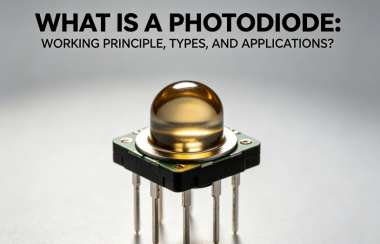
In modern optoelectronic technology and electronic information systems, the photodiode is a fundamental and critical optoelectronic conversion device. It is widely used in optical communications, industrial inspection, medical equipment, and consumer electronics. With the development of high-speed communication and high-precision sensing technologies, photodiodes play an increasingly important role in low-power, high-response optical detection systems. They can efficiently convert incident optical signals into electrical signals and are one of the core components for optoelectronic detection and optical information processing.
I. What is a Photodiode?
A photodiode is a photosensitive device based on a semiconductor PN junction structure. Its primary function is to convert light energy into current or voltage signals. When light is incident on the PN junction region, the semiconductor material absorbs photon energy and generates electron-hole pairs. Under the action of the built-in electric field, these carriers form a directional current output, thereby achieving optoelectronic conversion.
Structurally, a photodiode is similar to a conventional diode, but it is optimized with an improved light-incident window and depletion region design, which provides higher photoresponse efficiency and lower dark current characteristics.
II. Working Principle of Photodiodes
The working principle of photodiodes is mainly based on the photoelectric effect and the PN junction field separation mechanism, which together enable the conversion of optical signals into electrical signals.
First is the photoelectric effect principle. When photons are incident on a semiconductor material, if the photon energy is greater than the bandgap energy of the material, electrons absorb photon energy and transition from the valence band to the conduction band, generating electron-hole pairs. These carriers are quickly separated under the electric field of the PN junction, with electrons moving toward the N region and holes toward the P region, forming a photocurrent.
Second is the PN junction electric field mechanism. Within the depletion region of the PN junction, a built-in electric field exists that effectively accelerates the separation and collection of photogenerated carriers, reducing recombination losses and improving quantum efficiency. As light intensity increases, more electron-hole pairs are generated, and the output current increases linearly. Therefore, photodiodes are commonly used for precise light intensity detection.
In practical operation, photodiodes are usually operated in reverse bias mode to widen the depletion region and improve response speed and sensitivity.
III. Types of Photodiodes
According to structural and performance characteristics, photodiodes can be classified into several types, including PIN type, APD type, and PSD type.
The PIN photodiode introduces an intrinsic (I) layer between the P-type and N-type semiconductor regions. This design significantly expands the depletion region, thereby reducing junction capacitance and improving response speed and quantum efficiency. As a result, PIN photodiodes are widely used in optical communication systems, high-speed data receivers, and optical spectroscopy applications, making them one of the most mature and widely used types.
The APD (Avalanche Photodiode) has a structure similar to the PIN type, but it achieves carrier avalanche multiplication under a high electric field, providing internal signal gain. This structure enables extremely high sensitivity, making it suitable for weak light detection, LiDAR systems, long-distance optical communication, and high-precision measurement systems. However, it requires a higher operating voltage and more demanding circuit design.
The PSD (Position Sensitive Detector) photodiode is a specialized device used to detect the position and intensity distribution of a light spot. It typically consists of multiple photosensitive regions. By comparing the output current or voltage differences, the incident position of the light spot can be precisely calculated. It is widely used in autofocus systems, robotic vision positioning, and industrial measurement systems.
IV. Applications of Photodiodes
Due to their high sensitivity, fast response, and good linearity, photodiodes play an important role in various high-tech fields.
In optical communication systems, photodiodes are core components of optical receiver modules, converting optical signals transmitted through fiber into electrical signals, enabling high-speed data transmission and network communication.
In industrial automation and detection systems, photodiodes are used in photoelectric switches, encoders, position detection, and safety protection devices, enabling non-contact detection and precise control.
In medical and biomedical applications, photodiodes are commonly used in blood oxygen monitors, medical imaging equipment, and spectroscopic analysis instruments to capture weak optical signals for accurate analysis.
In consumer electronics, such as ambient light sensors in smartphones and automatic exposure systems in cameras, photodiodes are widely used for light intensity detection and automatic adjustment functions.
In aerospace and remote sensing systems, photodiodes are also used for Earth surface detection, satellite optical sensing, and environmental monitoring applications.
V. Conclusion
In summary, the photodiode is a highly efficient optoelectronic conversion device that has become a fundamental core component in modern electronic and optoelectronic systems due to its simple structure, fast response, and high reliability. With the continuous development of optical communication, intelligent sensing, and automation technologies, the performance of photodiodes will continue to improve, and their application range will further expand, playing an increasingly important role in future high-end electronic systems.


