
What Is the Working Principle and Operating Method of a Thermistor?


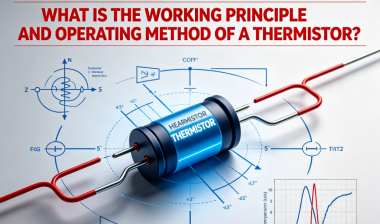
In the electronics components industry, the thermistor is one of the most common temperature-sensitive components in electronic circuits. It is widely used in temperature measurement, temperature compensation, over-temperature protection, and industrial control systems. As electronic devices continue to develop toward higher precision and greater reliability, thermistors have become increasingly important in consumer electronics, automotive electronics, medical devices, and industrial automation. Its core feature is the ability to rapidly and significantly change its resistance value in response to ambient temperature changes, thereby enabling the electrical conversion of temperature signals.
I. What is a Thermistor?
A thermistor is a resistor component made of semiconductor materials whose resistance changes significantly with temperature. According to different temperature characteristics, thermistors are mainly divided into Negative Temperature Coefficient (NTC) thermistors and Positive Temperature Coefficient (PTC) thermistors. NTC thermistors decrease in resistance as temperature increases, while PTC thermistors increase in resistance as temperature rises. This unique temperature-resistance relationship makes thermistors a key component in precision temperature sensing and protection circuits.
II. Working Principle of Thermistors
The working principle of thermistors is based on the carrier movement characteristics of semiconductor materials. As temperature changes, the number and mobility of electrons or charge carriers inside the material also change, resulting in variations in resistance.
In NTC thermistors, increasing temperature enhances the thermal excitation of electrons, allowing more charge carriers to participate in conduction while reducing lattice scattering effects, thus decreasing resistance. These materials typically use metal oxide semiconductors, such as mixed oxides of manganese, nickel, and cobalt.
In PTC thermistors, rising temperature causes physical changes in the material structure, such as polymer expansion or grain boundary changes, which weaken conductive pathways and lead to a sharp increase in resistance. This characteristic makes PTC thermistors highly suitable for overcurrent protection and resettable fuse applications.
III. Thermistor Operating Methods
The actual operating method of thermistors is typically based on a “temperature–resistance–voltage” conversion mechanism, enabling temperature measurement or circuit control.
In temperature sensing applications, thermistors are usually combined with a fixed resistor to form a voltage divider circuit, where temperature is indirectly calculated by measuring output voltage changes. Under constant current drive conditions, temperature can also be accurately derived by measuring resistance variations. This method is widely used in digital temperature sensor modules.
In protection circuits, PTC thermistors significantly increase their resistance when excessive current or abnormal temperature rise occurs, thereby limiting current flow and providing automatic protection. Once the temperature returns to normal, the resistance drops back to a low level, enabling self-reset functionality.
In high-precision applications, engineers often use multi-point calibration or bridge circuit configurations to improve measurement accuracy and reduce interference from power supply fluctuations and wire resistance.
IV. Applications of Thermistors
Thermistors are widely used in modern electronic systems, including the following areas:
In consumer electronics, thermistors are commonly used in smartphones, battery management systems, chargers, and household appliances for temperature monitoring and overheat protection. In new energy vehicles and power battery systems, NTC thermistors are used for battery pack temperature monitoring to ensure safe charging and discharging operations.
In industrial control systems, thermistors are widely applied in PLC systems, temperature control equipment, frequency converters, and industrial sensors for high-precision temperature feedback control. In medical devices, they are used in body temperature monitoring equipment and precision instrument temperature compensation.
In power supply and circuit protection applications, PTC thermistors are commonly used as overcurrent protection devices to prevent damage caused by sudden current surges. In automotive electronics systems, thermistors are also used for engine temperature monitoring, air conditioning temperature control, and battery thermal management systems.
V. Conclusion
A thermistor is a key electronic component that changes resistance based on material temperature characteristics, with its core function being the conversion between temperature and electrical signals. According to their characteristics, thermistors are divided into NTC and PTC types, corresponding respectively to decreasing or increasing resistance with rising temperature. In practical applications, temperature measurement and circuit protection can be achieved through voltage divider circuits, current measurement, or bridge circuit configurations. With advantages such as simple structure, high sensitivity, and low cost, thermistors have become an indispensable fundamental component in modern electronic systems.


