
What Are the Overcurrent Protection Methods for Thyristors?


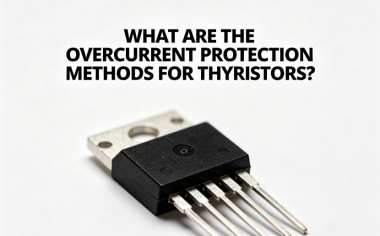
In the electronics components industry, the thyristor, as an important high-power semiconductor switching device, is widely used in rectification, motor speed control, power regulation, and industrial heating applications. Due to its characteristics of high voltage resistance, high current handling capability, and strong controllability, the thyristor holds an irreplaceable position in high-power scenarios. However, in practical operation, overcurrent is one of the key risks affecting the reliability and lifespan of thyristors. When the current exceeds the rated range, the internal power loss of the device increases sharply, causing rapid temperature rise and, in severe cases, permanent damage. Therefore, studying and properly designing thyristor overcurrent protection measures is of great significance for improving system safety and stability.
I. What is a thyristor?
A thyristor (Silicon Controlled Rectifier, SCR) is a four-layer, three-terminal semiconductor device with controllable conduction characteristics, mainly composed of an anode, a cathode, and a gate. Its core feature is that it remains in a blocking state under high voltage before triggering, and once a trigger signal is applied to the gate, it conducts. It automatically turns off only when the current drops below the holding current. Due to its simple structure, strong current handling capability, and low cost, the thyristor has long held an important position in industrial power control. However, because it operates in high-voltage and high-current environments, any overcurrent or short-circuit condition can pose a serious threat to device safety.
II. Working principle of the thyristor
The operation of a thyristor relies on the carrier injection and regenerative feedback mechanism of its internal PNPN structure. When a trigger signal is applied to the gate, a conduction path is formed inside the device, allowing current to flow from the anode to the cathode. Under normal operating conditions, the thyristor can stably maintain conduction and carry its rated current. However, when abnormal load conditions, circuit short circuits, or voltage transients occur, the current may instantly exceed the rated value, causing a rapid rise in junction temperature. Since a thyristor does not have an active turn-off capability once it is conducting, it must rely on external circuits or protection devices to interrupt the abnormal current; otherwise, it may enter thermal runaway and eventually fail.
III. Thyristor overcurrent protection measures
Thyristor overcurrent protection typically adopts a combination of multiple techniques to meet different power levels and application scenarios.
First, the overcurrent fuse is the most basic and widely used protection method. A fuse is connected in series in the circuit. When the current exceeds the rated value, the fuse melts quickly, disconnecting the circuit and preventing the thyristor from continuing to carry overload current. This method is simple and low-cost, but the component must be replaced after operation.
Second, inductive components can be used to limit the rate of current rise. By inserting an appropriate inductor into the circuit, di/dt (rate of current change) can be suppressed, effectively reducing the impact of sudden surge currents on the thyristor. This is particularly suitable for capacitive loads or systems with strong switching transients.
Third, electronic overcurrent protection devices are widely used in industrial systems. These devices monitor current in real time and quickly disconnect the circuit when the detected value exceeds a preset threshold. They also support delayed protection and multi-level protection functions, making them suitable for medium- to high-power industrial control systems with high adjustability and reliability.
Finally, fast cutoff devices represent a more advanced protection solution, typically implemented using high-speed switching devices combined with detection circuits. When abnormal current occurs, the device can disconnect the main circuit in an extremely short time while working with snubber circuits to suppress arcing and surge voltage. This solution is suitable for high-power and high-reliability power electronics systems, such as large rectifier equipment and industrial drive systems.
IV. Conclusion
In summary, the overcurrent issue of thyristors is a critical safety factor that must be carefully considered in power electronics system design. By properly configuring overcurrent fuses, inductive components, electronic overcurrent protection devices, and fast cutoff systems, the risk of damage caused by overcurrent can be effectively reduced, thereby improving overall system stability. In practical engineering applications, protection schemes should be comprehensively designed based on load characteristics, operating environments, and power levels to achieve reliable, efficient, and safe power control solutions.


