
What Is the Working Principle and Function of an Electronic Relay?


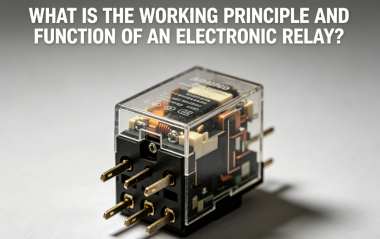
In the electronic components industry, the electronic relay is a key control device widely used in modern industrial and electronic systems. It uses electronic components to achieve circuit switching control. Compared with traditional mechanical relays, electronic relays offer significant advantages such as faster response speed, smaller size, longer service life, and lower operating noise. Therefore, they are widely used in industrial automation, new energy equipment, communication systems, and smart home applications. With the continuous development of electronic technology and semiconductor processes, electronic relays are gradually evolving toward higher integration and intelligence, becoming an essential part of modern circuit control systems.
I. What is an electronic relay?
An electronic relay (Electronic Relay) refers to an electronic switching device that uses semiconductor components (such as transistors, MOSFETs, or IGBTs) instead of traditional mechanical contact structures to control electrical loads. It controls the conduction and disconnection of output terminals through internal control circuits driven by input signals, enabling indirect control of high-voltage or high-current loads. Since there are no mechanical moving parts inside, electronic relays have significant advantages in reliability and stability, making them especially suitable for high-frequency switching and complex control environments.
II. Working principle of electronic relays
The operation of an electronic relay mainly consists of four parts: input circuit, control logic, switching components, and output circuit. The input circuit receives external control signals, which can be voltage, current, or digital pulse signals. The control logic circuit processes and evaluates the input signals and generates driving commands based on predefined conditions. Then, the driving signal is applied to power switching components (such as MOSFETs or IGBTs), causing them to switch between conduction and cutoff states. Finally, the switching components control the on/off state of the output circuit, enabling precise control of the load device. This semiconductor-based control method gives electronic relays extremely high response speed, typically reaching the microsecond level.
III. Functions of electronic relays
Electronic relays perform several important functions in electronic systems. First, they enable signal amplification by allowing small control signals to drive high-power loads. Second, they provide electrical isolation, effectively protecting the control circuit and load circuit and reducing system failure risks. In industrial control applications, electronic relays are commonly used to switch devices such as motors, heaters, and lighting systems. In addition, they offer fast protection capabilities; in cases of overload, short circuit, or abnormal current, they can quickly disconnect the circuit to prevent equipment damage. In automation systems, electronic relays also support complex logic control and remote control, greatly improving system flexibility and intelligence. Furthermore, due to their semiconductor structure, they have low power consumption and are suitable for long-term stable operation in electronic devices.
IV. Conclusion
Overall, electronic relays, with their high-speed response, high reliability, low power consumption, and compact structure, have become indispensable components in modern electronic control systems. Whether in industrial automation, power control, smart devices, or new energy systems, electronic relays play a critical role. With the continuous advancement of semiconductor technology and intelligent control technology, the application scope of electronic relays will further expand, and they will occupy an increasingly important position in the future electronic components industry.


