
How to Wire a Silicon Controlled Rectifier (SCR)?


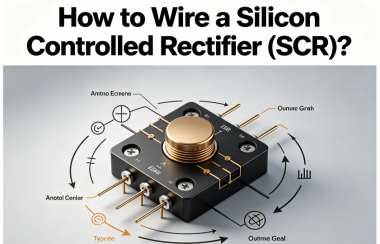
In the electronic components industry, the Silicon Controlled Rectifier (SCR) is a critical high-power semiconductor device. It is widely used in AC voltage regulation, controlled rectification, motor speed control, temperature control systems, and non-contact switching applications. With the development of industrial automation and new energy technologies, the importance of SCRs in power regulation continues to grow, making them an indispensable fundamental component in the electronics industry.
I. What is a Silicon Controlled Rectifier (SCR)?
A Silicon Controlled Rectifier, also known as a thyristor, is a semiconductor device with a four-layer, three-terminal structure. Its internal structure consists of alternating P-type and N-type semiconductor materials, forming a PNPN configuration. It has three main terminals: the anode, cathode, and gate. The anode and cathode are responsible for carrying the main current, while the gate controls the turn-on and turn-off of the device, serving as the core control terminal that enables its “controllable” behavior.
II. Working Principle of SCR
The working principle of an SCR is based on a double-transistor positive feedback structure. When a forward voltage is applied between the anode and cathode, the device remains in a non-conducting (off) state if no triggering signal is applied to the gate, and no current flows through it.
When a sufficient gate trigger current is applied, the internal PNPN structure forms a strong positive feedback loop, causing the device to rapidly switch from the off state to the conducting (on) state. Once turned on, even if the gate signal is removed, the SCR will continue to conduct as long as the anode current remains above the holding current.
When the anode current drops below the holding current, or when the external circuit applies reverse bias, the SCR returns to its blocking state. Therefore, it has the typical characteristics of “triggered conduction, maintained conduction, and natural turn-off.”
III. Wiring Methods of SCR
In practical electronic circuit design, the wiring method of an SCR must be selected according to the specific application scenario. The following are common configurations.
In phase-controlled rectifier circuits, the anode of the SCR is typically connected to the AC power input, while the cathode is connected to the load. The other side of the load is then connected back to the power source to form a complete circuit. The gate is connected to a trigger circuit to achieve precise control of the conduction angle.
In AC voltage regulation applications, the wiring structure is similar to phase-controlled rectification. However, the key point lies in adjusting the gate triggering angle. By changing the conduction phase, the effective output voltage can be controlled, enabling functions such as dimming, speed control, or heating power regulation.
In non-contact electronic switching applications, the SCR is used as an electronic switching device. The anode and cathode are connected in series with the load circuit, while the gate receives trigger signals from the control system, enabling high-frequency switching without mechanical wear.
In overvoltage protection circuits, the SCR is typically used together with a Zener diode or a varistor. When the voltage exceeds a preset threshold, the SCR is triggered into conduction, rapidly discharging abnormal current and protecting downstream electronic systems.
IV. Trigger Circuits of SCR
The trigger circuit is a key component that determines whether the SCR operates stably. Its main function is to provide a stable and sufficiently strong gate trigger current.
Common triggering methods include pulse transformer triggering, which provides electrical isolation between input and output. This method is suitable for high-voltage industrial environments and improves system safety.
Optocoupler triggering is another common solution. It uses optical signals to isolate the control side from the power side, offering strong anti-interference capability and simple structure. It is widely used in household appliances and industrial control equipment.
Transistor amplification trigger circuits use bipolar transistors or MOSFETs to amplify control signals so that they meet the gate trigger current requirements of the SCR. This method is suitable for low-voltage control systems.
In modern intelligent control systems, microcontrollers (MCUs) can directly output PWM or digital pulse signals. Through driver circuits, precise control of the SCR conduction angle can be achieved, enabling high-precision power regulation.
V. Precautions
When designing and installing circuits using SCRs, several key factors must be carefully considered.
First, the polarity of the anode and cathode must be correctly identified. Incorrect wiring may cause permanent damage to the device. Second, the gate trigger current must meet the device specifications; otherwise, the SCR may fail to turn on or operate unstably.
In high-power applications, adequate heat dissipation measures such as heat sinks or forced air cooling must be provided to prevent excessive junction temperature, which can reduce device lifespan. In addition, appropriate voltage and current ratings should be selected according to application requirements to ensure reliable system operation.
In high-voltage or inductive load scenarios, RC snubber circuits or varistors should be added to suppress surge voltage and electromagnetic interference, thereby improving system stability.
VI. Conclusion
As an important semiconductor device in the field of power electronics, the SCR is widely used in industrial control and power management systems due to its controllable conduction, high power-handling capability, and flexible control methods. A deep understanding of its working principle and triggering mechanism is essential for correct circuit design.
In practical applications, properly selecting wiring methods and trigger circuits, while strictly following polarity, thermal management, and protection design requirements, can significantly improve system stability and safety. With the continuous development of electronic control technologies, SCRs will play an even more important role in intelligent power regulation and efficient energy management applications.


