
Kioxia Rises to Japan No.3 on Wafer Bonding Boom


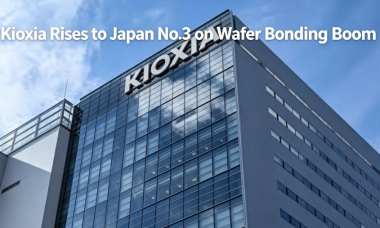
According a report by the Nikkei, the market capitalization of Japan’s NAND flash memory leader Kioxia has surged more than 30-fold over the past year amid the global artificial intelligence boom. The company’s valuation has recently stabilized in the range of ¥39–40 trillion (approximately US$250 billion), making it the third most valuable company in Japan, behind SoftBank Group and Toyota Motor.
This rapid increase is largely driven by soaring demand for NAND flash memory from AI data centers, alongside Kioxia’s technological lead in wafer bonding innovations. These advancements have strengthened its competitive position against South Korean memory giants Samsung Electronics and SK Hynix.
In NAND flash technology evolution, increasing storage capacity through vertical stacking of memory cells has been the dominant approach. Kioxia’s predecessor, Toshiba, pioneered this architecture as early as 2007. However, when Kioxia introduced its 218-layer NAND product in 2023, SK Hynix soon followed by announcing development plans for 300+ layer devices, temporarily placing Kioxia in a catch-up position in terms of layer count.
To overcome this challenge, Kioxia has focused on wafer bonding technology as a strategic breakthrough. Traditional NAND designs integrate memory cells and CMOS control circuits on a single silicon wafer. In contrast, Kioxia’s CMOS Direct Bonded to Array (CBA) technology—commercialized in 2023—fabricates the memory array and control circuitry on separate wafers and then bonds them with high precision.
This architecture significantly improves layout efficiency and increases storage density. Due to its high technical complexity, Kioxia was the first to commercialize this approach, achieving read and write performance improvements of approximately 20%–30% compared with competing solutions.
Although CBA was initially considered too difficult for mass production, accelerating AI server deployment has rapidly expanded demand for high-bandwidth and high-speed memory solutions, making the technology a core part of Kioxia’s product lineup. At the same time, early aggressive investment by Korean rivals into DRAM during the AI cycle led to a relative slowdown in NAND-focused development, giving Kioxia a strategic window to advance its leadership in this segment. While its overall market share still trails Samsung Electronics and SK Hynix, strong demand for CBA-based products has significantly boosted investor valuation.
On capacity expansion and future plans, Kioxia CEO Yukio Ota stated that the company’s most advanced product is currently its 8th-generation NAND. Alongside capacity expansion at its Yokkaichi plant in Mie Prefecture, Kioxia is increasing investment in its Kitakami facility in Iwate Prefecture. The Kitakami site is expected not only to produce 8th-generation NAND but also to begin mass production of 10th-generation devices in the future.
To capture AI-driven market opportunities, Kioxia plans to invest more than ¥450 billion (approximately US$2.8 billion) in fiscal 2026 (April 2026–March 2027) for equipment upgrades and production expansion. The company has also received approximately ¥250 billion in subsidies from the Japanese government to support its advanced semiconductor manufacturing initiatives.


