
How to Select a TVS Diode?


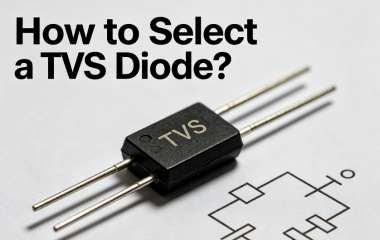
In modern electronics industry, as circuit operating frequencies continue to increase and device complexity grows, circuits have become more sensitive to overvoltage conditions. Transient voltage events may be caused by lightning strikes, power supply fluctuations, electromagnetic interference (EMI), or electrostatic discharge (ESD), all of which can cause irreversible damage to electronic components. The TVS (Transient Voltage Suppressors) diode, also known as a transient voltage suppressor, is a key component specifically designed to protect electronic circuits from transient overvoltage damage. With its high response speed, precise clamping capability, and strong reliability, it is widely used in automotive electronics, communication equipment, industrial control, and consumer electronics. This article provides a systematic introduction to the definition, selection methods, selection precautions, characteristics, and typical applications of TVS diodes, offering comprehensive reference for engineers and electronic designers.
I. What is a TVS Diode?
A TVS diode is a semiconductor device composed of one or multiple PN junctions, featuring transient voltage suppression capability. Depending on structure and application, TVS diodes can be divided into two types: unidirectional and bidirectional.
Unidirectional TVS diodes are mainly used in DC circuits. Under normal operating conditions, they remain in a high-impedance state. When abnormal overvoltage occurs, they quickly conduct and clamp the voltage within a safe range.
Bidirectional TVS diodes are mainly used in AC circuits or bidirectional pulse signal circuits. They can suppress transient voltages in both positive and negative directions, thereby protecting circuit components.
The working principle of TVS diodes is based on the avalanche breakdown effect. When an abnormal overvoltage exceeds its breakdown voltage, the device switches from a high-impedance state to a low-impedance state, diverting the transient overcurrent to ground and effectively protecting downstream circuits.
II. TVS Diode Selection Methods
In electronic design, correctly selecting a TVS diode is critical to ensuring circuit safety. The main selection methods include:
1.Determine the protection circuit voltage: clearly define the maximum DC or continuous operating voltage of the protected circuit, as well as its rated voltage tolerance.
2.Select an appropriate reverse stand-off voltage (VWM): VWM should be greater than or equal to the maximum operating voltage of the circuit to avoid false triggering or excessive leakage current affecting normal operation.
3.Maximum clamping voltage (VC) control: VC should be lower than the damage threshold of the protected circuit to ensure overvoltage is safely limited.
4.Peak pulse power (PW) matching: the peak pulse power rating of the device must be greater than the expected transient surge power.
5.Peak pulse current consideration: after determining VC, ensure the peak pulse current is greater than the surge current.
6.Low-capacitance selection for data interfaces: for high-speed signal lines, low-capacitance TVS devices should be selected to avoid signal distortion.
7.Device marking identification: TVS diodes with an “A” suffix generally have better parameter consistency, while those with “C” indicate bidirectional TVS devices.
8.Circuit type matching: DC protection typically uses unidirectional TVS diodes, AC protection uses bidirectional types, multi-line protection uses TVS arrays, and high-power protection uses dedicated modules.
9.Temperature influence consideration: TVS devices operate from -55°C to +150°C, but leakage current increases with temperature, requiring design margin.
10.Series/parallel application caution: series connection divides voltage and parallel connection divides current, but the number of devices should be minimized to reduce parameter deviation.
III. TVS Diode Selection Considerations
In practical selection, in addition to basic parameters, the following factors should also be considered:
Pulse width: the power absorption values in datasheets are based on specific pulse widths; derating is required for varying pulse widths in real applications.
Low-current circuits: add current-limiting resistors to prevent damage from excessive transient current.
Steady-state power: ensure the average power remains within the safe operating range of the device.
Temperature effects: derating is required in high-temperature environments.
Lead length: longer leads reduce response speed; keep leads as short as possible.
Data interface protection: low-capacitance TVS devices should be used to minimize signal distortion.
Circuit type matching: unidirectional for DC, bidirectional for AC, and array modules for multi-line protection.
Parasitic variation management: minimize series/parallel configurations to improve stability.
IV. Characteristics of TVS Diodes
TVS diodes exhibit a variety of excellent characteristics that make them indispensable in electronic protection applications:
Manufactured using semiconductor processes, offering high reliability and no defined failure threshold;
Precise glass passivation process ensures stable breakdown voltage;
Low capacitance and low leakage current with high transient power capability and controllable clamping voltage;
Extremely fast response time, typically less than 1 picosecond;
Small breakdown voltage deviation with high voltage accuracy suitable for precision applications;
Compact size and easy installation with multiple package types, including surface-mount packages (SOD-123, SMA, SMB, SMC) and through-hole packages (DO-41, DO-15, DO-201);
Wide operating voltage range from 3.3V to 600V and above;
RoHS-compliant and halogen-free;
Transient power capability ranges from 200W to 30,000W under 10/1000 μs waveform conditions.
V. Typical Applications of TVS Diodes
Due to their fast response and high-precision clamping characteristics, TVS diodes are widely used in various electronic fields:
Automotive electronics: vehicle control systems and sensor protection;
Communication equipment: RS-485, RS-232 interfaces, and power line protection;
Industrial control: PLC systems, sensor interfaces, and power line protection;
Home appliances and lighting: power management and overvoltage protection;
Medical equipment: protection of precision electronic instruments;
Consumer electronics: smartphones, tablets, laptops, and interface protection.
TVS diodes rapidly absorb transient energy and clamp high voltage within a safe range, effectively extending device lifespan and improving system reliability.
VI. Conclusion
As electronic products continue to advance and operating environments become increasingly complex, overvoltage protection has become more critical than ever. TVS diodes, with their high reliability, fast response, and precise clamping capability, have become the preferred choice for engineers in circuit protection design. Proper selection and application of TVS diodes not only effectively prevent damage to electronic components but also significantly enhance system safety and stability, making them an indispensable part of modern electronic product design.


