
What Are the Four Main Applications of Inductors in Circuits?


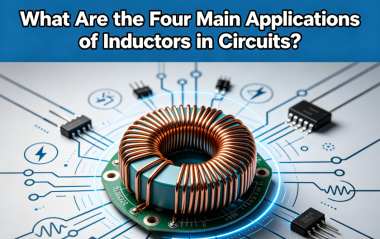
In the electronic components industry, inductors, as one of the fundamental and critical passive components, are widely used in power management, signal processing, and radio frequency communication. With the development of electronic devices toward higher frequency, miniaturization, and higher reliability, the importance of inductors in stabilizing current, suppressing noise, and energy conversion has become increasingly prominent. Whether in consumer electronics, industrial control, or new energy vehicle systems, inductors play an indispensable role.
I. What is an Inductor?
An inductor is an electronic component that can convert electrical energy into magnetic field energy and store it, usually made by winding conductive wire around a magnetic core or air core. Its core characteristic is “inductance,” measured in henries (H). When current flows through an inductor, a magnetic field is generated around it, which resists changes in current. This property makes inductors highly valuable in filtering, energy storage, and oscillation circuits.
II. Working Principle of Inductors
The working principle of inductors is based on Faraday’s law of electromagnetic induction. When current flows through a coil, a magnetic field is generated and energy is stored; when the current changes, the magnetic field also changes, inducing an electromotive force in the inductor that opposes sudden changes in current. This “resistance to change” allows inductors to smooth current fluctuations, suppress high-frequency noise, and achieve frequency selection in AC signal processing.
In essence, inductors exhibit the characteristic of “passing DC while resisting AC (especially high-frequency signals),” which is the fundamental reason for their wide application in electronic circuits.
III. Four Applications of Inductors in Circuits
1. Inductive Filter
Inductive filters are widely used in power circuits and signal processing circuits. Their main function is to suppress high-frequency noise and electromagnetic interference (EMI). In switching power supplies, inductors effectively smooth current waveforms and reduce ripple, thereby improving output stability. In audio systems, inductive filters can reduce high-frequency noise and improve sound quality.
2. Energy Storage and Conversion Component
Inductors can serve as transient energy storage components and play a key role in power conversion processes. For example, in DC-DC converters, inductors achieve voltage step-up or step-down through energy storage and release cycles. This makes them an essential part of modern power management integrated circuit systems.
3. Resonant Circuits and Frequency Selection
In LC resonant circuits, inductors work together with capacitors to form oscillating circuits at specific frequencies. This structure is widely used in wireless communication, radio frequency identification (RFID), and broadcast reception systems for signal selection, amplification, and frequency tuning, enabling precise frequency control and signal processing.
4. Transient Suppression and Circuit Protection
Inductors can also be used to suppress transient voltage and current surges in circuits. When sudden current changes or power surges occur, inductors absorb part of the energy through their storage capability, thereby slowing down current variation and reducing stress on sensitive components. This makes them important protection elements in industrial power systems, automotive electronics, and communication equipment.
IV. Conclusion
As a fundamental component in electronic circuits, the core value of inductors lies in their ability to store energy and control current variations. From power filtering and energy conversion to resonant tuning and transient protection, inductors play a multi-dimensional role in modern electronic systems. With the advancement of high-frequency electronics and intelligent devices, the performance requirements for inductors continue to increase, and their importance in the electronic component industry chain will further grow.


