
Nichicon Raises Capacitor Prices


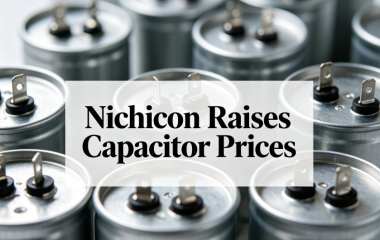
According to market reports, Japanese capacitor manufacturer Nichicon has issued a price increase notice to customers, announcing higher prices across its entire aluminum electrolytic capacitor portfolio. As one of the world's leading aluminum capacitor producers, Nichicon’s move is expected to influence pricing throughout the passive component industry, potentially encouraging Taiwanese manufacturers such as Kaimei, Lelon Electronics, and Jamicon to implement similar adjustments and strengthen profitability.
Aluminum electrolytic capacitors have become the latest passive component category to face pricing pressure, following previous increases in multilayer ceramic capacitors (MLCCs) and tantalum capacitors. According to industry sources, Nichicon did not disclose the exact scale of the increase but cited ongoing geopolitical instability in the Middle East, rising costs for aluminum foil, chemical materials, and electricity, as well as production capacity constraints caused by strong order demand.
The reported customer notice stated that orders for certain product lines have exceeded the company’s current manufacturing capacity. While Nichicon continues to expand production through equipment investments, additional machinery purchases, employee overtime, and weekend operations, sourcing raw materials has become increasingly challenging. At the same time, aluminum foil, chemical material, and energy costs continue to rise. To maintain stable product supply, support research and development efforts, and fund equipment upgrades, the company has decided to adjust aluminum electrolytic capacitor prices.
Industry analysts noted that the aluminum capacitor market has undergone a period of correction and supply chain restructuring in recent years, resulting in improved market discipline. Demand from AI servers, high-performance computing (HPC) platforms, and advanced power systems has accelerated, driving strong growth in demand for high-end aluminum capacitors. Nichicon’s decision to raise prices reflects not only cost inflation but also a tightening supply-demand environment, which could support broader pricing improvements across the sector.
In Taiwan, Kaimei, a subsidiary of Yageo Group, has been actively expanding its presence in the high-end aluminum capacitor market. Its product portfolio includes liquid aluminum electrolytic capacitors, polymer solid capacitors, and hybrid polymer capacitors for industrial, automotive, and power management applications. Supported by robust AI server demand and rising prices among Japanese competitors, Kaimei has experienced strengthening order momentum, with market observers expecting the company to benefit from both pricing improvements and potential order transfers.
Lelon Electronics, another major aluminum capacitor manufacturer, has continued to strengthen its position in automotive, industrial automation, and server applications. Industry analysts believe that tighter capacity among Japanese suppliers and ongoing price increases could enable Lelon to secure additional customer orders while enhancing its product mix and profit margins.
Meanwhile, Jamicon has seen rapid growth in cloud computing and server-related business. During the first quarter, revenue from cloud and server applications increased to 35% of total sales, up from 22% for the full previous year. AI-related applications accounted for approximately half of that segment. As customers continue expanding AI server deployments and data center infrastructure, demand is expected to remain strong in the second half of the year.
To support future growth, Jamicon has launched capacity expansion projects at its manufacturing facilities in Guangzhou and Thailand. The Guangzhou plant focuses on liquid aluminum electrolytic capacitors, while the Thailand facility primarily produces solid capacitors. The company expects new production capacity to come online gradually during the second half of the year, potentially doubling its overall output capacity. By the end of the year, production capacity for snap-in aluminum capacitors at the Guangzhou facility is projected to reach between 1.5 million and 2 million units per month, helping the company expand its market share in the growing AI and data center power infrastructure market.


