
How to Distinguish NO and NC Relay Contacts?


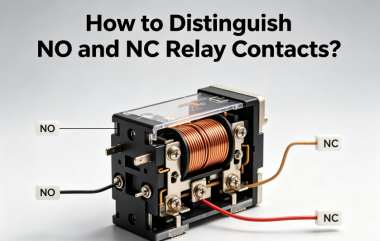
In the electronic components industry, relays are fundamental and critical control devices widely used in power control, signal switching, and automation systems. Their core function is to control high current using a low current signal, enabling automatic switching of electrical circuits. Therefore, they are often referred to as “electrically controlled switches.” With the development of smart manufacturing and industrial control systems, relays continue to play an important role in automotive electronics, home appliance control, communication equipment, and industrial control cabinets, serving as a basic component for understanding circuit control logic.
I. What is a Relay?
A relay is an electrically controlled device. When the input (typically voltage or current) reaches a specified threshold, it causes a predetermined step change in the controlled output circuit, enabling switching or control of electrical circuits. Its essence is to achieve electrical isolation and signal conversion between the control side and the load side through electromagnetic, thermal, or solid-state mechanisms. The most common type is the electromagnetic relay, which uses a coil-generated magnetic field to drive mechanical contacts.
II. Working Principle of a Relay
The working principle of a relay is mainly based on electromagnetic induction. A typical electromagnetic relay consists of a coil, iron core, armature, spring, and contact system. When voltage is applied across the coil, current flows through it and generates a magnetic field. The iron core becomes magnetized, attracting the armature and causing it to move.
This mechanical movement drives the contact system to change state, either closing an originally open circuit or opening an originally closed circuit.
When the coil is de-energized, the magnetic field disappears, and the armature returns to its original position under spring force, restoring the contacts to their initial state. Through this “electrical–magnetic–mechanical–electrical” conversion process, relays achieve safe control and isolation of high-voltage and high-current loads.
III. Normally Open and Normally Closed Contacts (NO and NC)
In relay contact structures, Normally Open (NO) and Normally Closed (NC) are the two most fundamental types. Their states depend on whether the relay is energized.
Normally Open (NO)
Normally Open contacts refer to a state in which the contacts remain open when the relay is not energized or not activated. When the coil is energized, the contacts close and complete the circuit.
NO contacts are typically used in control scenarios where conduction is required only under specific conditions, such as start circuits in automation systems, access control systems, or alarm triggering circuits. Their key feature is that they remain off by default, providing higher safety and preventing unintended activation of loads.
Normally Closed (NC)
Normally Closed contacts refer to a state in which the contacts remain closed when the relay is not energized, allowing current to flow through the circuit. When the coil is energized, the contacts open and interrupt the circuit.
NC contacts are commonly used in protection or monitoring circuits, such as overcurrent protection, temperature alarms, or safety interlock systems. When an abnormal condition occurs, the relay activates and breaks the circuit to provide protection.
IV. Methods for Distinguishing NO and NC Contacts
In practical applications and maintenance, accurately identifying NO and NC contacts is essential. The following methods are commonly used:
First, check the markings on the relay housing or the product datasheet, as most relays clearly label NO and NC terminals.
Second, use a multimeter for testing. When the relay is not energized, measure the contact resistance: if it is close to zero, it is likely an NC contact; if it is infinite, it is likely an NO contact.
Additionally, relay symbols in circuit diagrams can also be used for identification. NO contacts are typically represented as an open switch symbol, while NC contacts are shown as a closed switch symbol.
V. Precautions When Using Relays
In practical circuit design and application, it is important to pay attention to the rated parameters of the relay, including coil voltage, contact current, and load type, to avoid contact wear or failure due to overloading.
For high-frequency switching or inductive loads (such as motors or solenoid valves), contact arcing should be considered. If necessary, absorption or protection circuits should be added to extend the service life of the relay.
During installation, maintenance, or replacement of relays, ensure that the power supply is completely disconnected to avoid electric shock or equipment damage. Additionally, environmental temperature and humidity should be considered, and long-term operation beyond specified conditions should be avoided.
VI. Conclusion
As one of the most fundamental control components in the electronic components industry, relays play a crucial role in enabling low-power control of high-power circuits and providing electrical isolation. By understanding their working principles and the structural characteristics of NO and NC contacts, engineers can better design circuits and troubleshoot faults. In modern industrial automation and electronic systems, relays remain indispensable fundamental components, significantly enhancing system safety and reliability.


