
What Is a Relay Module and Its Pros and Cons?


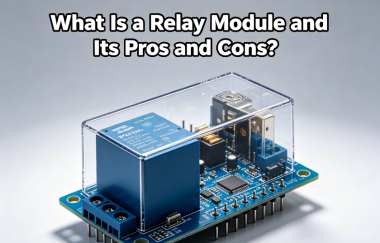
In the electronics components industry, the relay module serves as an important intermediate device that connects low-power control signals with high-power load circuits. It is widely used in household appliance control, PLC systems, smart buildings, mechanical equipment, and communication systems. With the development of intelligent manufacturing and the Internet of Things (IoT), relay modules have become an indispensable fundamental component in electrical control systems due to their stability and safety isolation capabilities. This article provides a systematic analysis of relay modules from the perspectives of definition, working mechanism, and advantages and disadvantages.
I. What is a Relay Module?
A relay module is a standardized electronic control module that integrates multiple relays along with their driving, protection, and interface circuits. Its core principle is to use a low-current control signal to drive an electromagnetic relay, thereby enabling the switching control of high-voltage or high-current load circuits.
Compared with a single relay, a relay module typically integrates features such as optocoupler isolation, indicator LEDs, power management, and input/output interfaces. These integrations allow it to interface more easily with PLCs, microcontrollers, or industrial control systems, improving system integration and reliability.
II. Functions of Relay Modules
Relay modules play several key roles in electronic and industrial control systems.
First is circuit switching control. Through a low-current input signal, the relay module can control the on/off state of high-power output loads, achieving low-voltage control of high-voltage circuits with electrical isolation. It is widely used in motor control, lighting systems, and automation equipment.
Second is circuit protection. When abnormal conditions such as overcurrent or overvoltage occur, the relay module can work with the control system to quickly disconnect the load circuit, thereby protecting downstream equipment from damage and improving overall system safety and stability.
Third is signal isolation and conversion. Through electromagnetic isolation, relay modules separate control signals from load circuits, preventing high-voltage interference from entering the control side. They can also enable switching and adaptation between different voltage levels.
Finally is system expansion and control regulation. In complex control systems, relay modules act as extended output units, enabling logical combination control through multi-channel operation and improving system flexibility and scalability.
III. Advantages of Relay Modules
Relay modules offer several advantages that contribute to their widespread use in industrial and consumer applications.
First, high reliability and stability. Relay modules are based on mature structural designs and can handle relatively high load currents while maintaining stable performance over repeated switching operations, making them suitable for long-term industrial use.
Second, strong electrical isolation. Through electromagnetic isolation, relay modules effectively separate the control side from the load side, reducing electromagnetic interference and improving system safety levels.
Third, wide applicability. Relay modules can be used in both DC and AC circuits and support load control across different voltage levels, offering strong versatility.
Fourth, flexible control methods. Relay modules are compatible with various input control signals, such as TTL logic levels and PLC outputs, making system integration and upgrades easier.
Fifth, modular design for easy maintenance. Relay modules typically adopt standardized structures, allowing quick replacement in case of failure, which reduces maintenance costs and improves system serviceability.
IV. Disadvantages of Relay Modules
Despite their strong practicality, relay modules still have certain limitations in some high-performance applications.
First is power loss. Contact resistance in relay contacts generates energy loss during conduction, which may cause localized heating.
Second is relatively slow switching speed. Because mechanical contacts require physical movement, the response speed of relay modules is significantly slower than semiconductor switching devices, making them unsuitable for high-speed switching applications.
Third is electromagnetic interference. During switching, the relay coil generates back electromotive force, which may cause electromagnetic interference to surrounding circuits. Additional suppression and filtering design is often required.
Fourth, they are not suitable for high-frequency control. Due to mechanical structural limitations, relays cannot operate at high switching frequencies and may suffer from instability or reduced lifespan in such conditions.
Fifth, lifespan is affected by mechanical wear. Although relay modules generally have a long service life, contact wear still occurs, especially under high-frequency operation, which may lead to performance degradation.
V. Conclusion
Overall, relay modules, as fundamental actuating components in electronic control systems, play an important role in circuit isolation, load control, and system protection. Their advantages lie mainly in high reliability, strong isolation, and broad applicability, while their disadvantages are mainly related to slower switching speed and mechanical lifespan limitations.
In practical applications, appropriate selection between relay modules and other switching devices should be based on specific control requirements, load characteristics, and system response speed requirements, in order to achieve an optimal balance between performance and cost.


