
TSMC Strengthens DRAM Supply Chain with Winbond


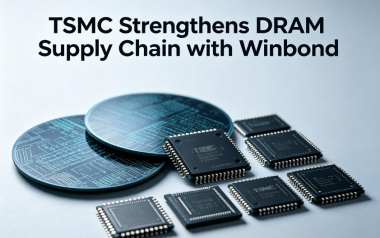
According to industry sources, Taiwan Semiconductor Manufacturing Co. (TSMC) is accelerating efforts to strengthen its domestic DRAM supply chain amid a global memory shortage, with Winbond Electronics emerging as a key partner in a strategic collaboration focused on next-generation AI applications. The partnership is expected to provide TSMC with a more stable source of memory wafers while enabling Winbond to expand its role within the rapidly growing AI server ecosystem, highlighting Taiwan’s deeper integration into the global AI semiconductor value chain.
Winbond declined to comment on specific customers or partnership projects, while TSMC had not responded to requests for comment as of publication. Sources familiar with the matter indicated that the collaboration centers on advanced Wafer-on-Wafer (WoW) 3D stacking technology. Under the arrangement, Winbond will contribute DRAM and other memory wafers that can be vertically integrated with TSMC’s logic wafers using advanced stacking processes.
Historically, TSMC’s WoW technology has relied heavily on memory wafers from major international memory manufacturers, including Samsung, SK hynix, and Micron. However, tightening global memory supply has increased the need for additional qualified memory partners. Industry observers believe Winbond’s participation in TSMC’s WoW ecosystem could enhance supply chain resilience while creating long-term benefits for both companies.
WoW technology is widely regarded as one of the most important integration platforms for future AI processors. By leveraging hybrid bonding technology, WoW enables the direct vertical stacking of logic and memory wafers through thousands to millions of microscopic copper interconnects. This architecture significantly reduces data transmission distances and delivers higher bandwidth, lower latency, and improved energy efficiency compared with conventional packaging methods. As a result, WoW is becoming a critical technology for AI servers, high-performance computing (HPC) systems, and future edge AI devices.
Industry analysts note that TSMC maintains exceptionally stringent requirements for WoW partners. Companies must possess advanced 12-inch wafer manufacturing capabilities, high production yields, specialized process expertise, and extensive wafer integration experience. Winbond’s long-standing presence in specialty DRAM and NOR Flash memory markets, combined with its strengths in memory process technologies, wafer fabrication, and quality management, has positioned the company as a valuable participant in TSMC’s expanding AI memory ecosystem.
As memory demand continues to outpace supply, production capacity at major global memory manufacturers remains heavily utilized. The worldwide AI supply chain is increasingly seeking diversified and flexible memory sources to support the rapid expansion of AI infrastructure. In response, TSMC is not only deepening relationships with leading international memory companies but also strengthening cooperation with domestic partners to build a more resilient and comprehensive AI chip ecosystem.
The inclusion of Winbond in TSMC’s AI memory supply chain represents more than a single business agreement. It reflects TSMC’s broader strategy of cultivating local semiconductor capabilities to enhance supply security and support the growing requirements of advanced AI chip development.
With TSMC leading the integration of domestic memory resources into advanced AI manufacturing, Taiwan’s memory industry is evolving from a supporting role into a core contributor to the global AI supply chain. As WoW technology moves toward larger-scale production and broader adoption across future AI platforms, Winbond could gain significant new growth opportunities while further strengthening Taiwan’s strategic position in the global semiconductor and AI landscape.


