
How Does an Overcurrent Relay Work?


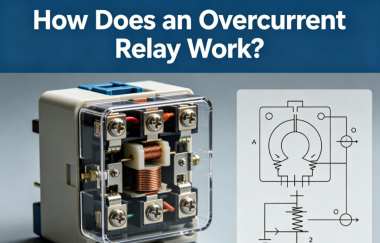
In the electronic components industry, the Overcurrent Relay (OCR) is an indispensable device in electrical protection systems. It continuously monitors the current flowing through a circuit and, once the current exceeds a preset threshold, sends a control signal or disconnects the faulty circuit. This effectively protects motors, transformers, power distribution lines, and other electrical equipment from damage. This article provides a comprehensive overview of overcurrent relays, including their definition, working principle, primary functions, practical applications, and selection considerations.
I. What Is an Overcurrent Relay?
An overcurrent relay is a protective relay designed to detect when the current in a circuit exceeds a predetermined value and initiate a protective action in the event of overloads, short circuits, or other abnormal operating conditions. It is an essential component of electrical protection systems and is widely used in low-voltage distribution systems, medium- and high-voltage power transmission and distribution networks, industrial control equipment, renewable energy systems, and motor protection applications.
II. How Does an Overcurrent Relay Work?
The primary function of an overcurrent relay is to continuously monitor circuit current and determine whether protective action is required based on preset protection parameters. Its operating process generally consists of four stages: current detection, signal processing, logic evaluation, and protection execution.
First, a Current Transformer (CT) converts the high current in the main circuit into a proportional low-current signal suitable for measurement by the relay. The relay continuously samples and monitors this current signal, comparing it with the preset pickup current value.
When the measured current exceeds the configured threshold, the relay determines whether to operate according to its protection settings. If instantaneous overcurrent protection is selected, the relay immediately outputs a trip signal. If definite-time or inverse-time overcurrent protection is used, it delays operation according to the configured time settings to prevent nuisance tripping caused by temporary inrush currents, such as motor startup or capacitor switching.
Once the relay confirms that the fault condition persists, its output contacts operate and send a control signal to the circuit breaker trip coil, contactor, or PLC control system, disconnecting the faulty circuit or executing the required protective action. After the fault has been cleared and normal operating conditions have been restored, the relay can be reset automatically or manually, depending on the system configuration.
Traditional electromagnetic overcurrent relays rely on the magnetic force generated by a coil to drive mechanical contacts. In contrast, modern electronic and digital overcurrent relays utilize microprocessors for high-speed calculations, enabling more accurate protection while supporting fault recording, self-diagnostics, remote communication, and multiple protection curve settings. These capabilities significantly improve the reliability and intelligence of modern power systems.
III. Functions of an Overcurrent Relay
1. Preventing Electrical Equipment Damage Caused by Overloads
Long-term overload operation can cause excessive winding temperatures, insulation degradation, and even equipment burnout. An overcurrent relay continuously monitors operating current and initiates protective action when the current exceeds the equipment's rated value, effectively protecting motors, transformers, cables, and other electrical equipment while extending their service life.
2. Rapidly Clearing Short-Circuit Faults
A short circuit can cause the circuit current to increase dramatically within a very short period. If the fault is not cleared promptly, it may result in severe equipment damage or safety hazards. An overcurrent relay quickly detects excessive current and works together with a circuit breaker to isolate the fault, minimizing equipment damage and reducing downtime.
3. Improving Power System Reliability
In power distribution systems, multiple overcurrent relays can be coordinated according to protection grading principles. When a fault occurs in a specific section of the network, only the affected circuit is disconnected, allowing the remaining system to continue operating normally. This improves power supply continuity and overall system reliability.
4. Reducing Fire Risks and Safety Hazards
Prolonged overcurrent conditions can overheat conductors, accelerate insulation aging, and potentially cause electrical fires. Overcurrent relays disconnect faulty circuits before dangerous conditions escalate, reducing the risk of electrical fires, equipment explosions, and electric shock accidents.
5. Maintaining Power Quality
Abnormal overcurrent conditions not only affect faulty equipment but may also cause voltage fluctuations and unstable power supply, impacting other connected devices. By rapidly isolating faulted circuits, overcurrent relays help minimize fault propagation and maintain overall power quality and system stability.
6. Enabling Automated Protection and Intelligent Control
Modern digital overcurrent relays commonly support communication protocols such as RS485, Modbus, and IEC 61850, allowing seamless integration with PLCs, DCS, SCADA, and intelligent power distribution systems. They enable remote monitoring, fault alarms, event recording, and automated control, making them widely used in industrial automation, smart grids, renewable energy generation, and railway systems.
IV. Typical Applications of Overcurrent Relays
With the rapid development of industrial automation and intelligent power distribution technologies, overcurrent relays have found applications in a wide range of industries. Common application scenarios include:
1.Motor overload and locked-rotor protection;
2.Protection for distribution panels, low-voltage switchgear, and high-voltage switchgear;
3.Power transformer protection;
4.Overcurrent protection for power transmission and distribution lines;
5.Generator and backup power system protection;
6.Protection for photovoltaic, wind power, and energy storage systems;
7.Industrial automation production line control;
8.Large-scale industrial projects in petrochemical, power generation, metallurgy, and railway industries.
Since different applications require different pickup currents, operating times, and protection characteristics, selecting the appropriate relay type and protection settings according to actual operating conditions is essential.
V. How to Choose the Right Overcurrent Relay
When selecting an overcurrent relay, several factors should be considered, including the equipment's rated current, system voltage level, prospective fault current, protection target, operating characteristics, and installation environment. It is also important to evaluate measurement accuracy, operating speed, communication interfaces, ingress protection (IP) rating, and support for advanced features such as multi-stage protection, event recording, and remote configuration. Proper relay selection not only improves protection performance but also minimizes nuisance trips and protection failures, ensuring the long-term stable operation of the entire electrical system.
VI. Conclusion
An overcurrent relay is one of the most important protective devices in power systems and electronic equipment. Its primary role is to continuously monitor circuit current and initiate protective action whenever overloads, short circuits, or other abnormal current conditions occur, thereby preventing equipment damage and ensuring operational safety. With the advancement of digitalization and intelligent technologies, modern overcurrent relays not only provide highly accurate and reliable current protection but also integrate communication, data logging, remote monitoring, and intelligent diagnostics. As a result, they play an increasingly vital role in industrial automation, smart manufacturing, renewable energy, power distribution, and electronic equipment. A thorough understanding of the working principles, functions, applications, and selection criteria of overcurrent relays helps engineers design safer, more reliable, and more efficient electrical systems.


