
Does a Potentiometer Adjust Voltage or Current?


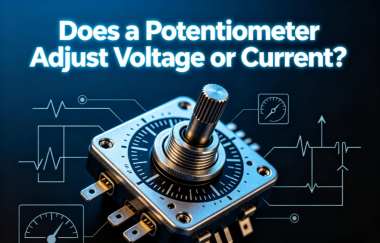
In the electronic components industry, a potentiometer is one of the most widely used adjustable components. It is commonly found in consumer electronics, industrial control systems, automotive electronics, audio equipment, medical instruments, and power supply systems. Whether it is used to adjust volume, control brightness, or set the output voltage, a potentiometer plays a vital role. During component selection or application, many users often ask: What is the primary function of a potentiometer? Does a potentiometer adjust voltage or current? This article answers these common questions and helps you better understand the working principle and practical applications of potentiometers.
I. What Is a Potentiometer?
A potentiometer is a three-terminal variable resistor that changes the position of its sliding contact by rotating a knob or moving a slider, thereby varying the resistance between the output terminal and the two end terminals to achieve voltage adjustment or signal control.
Structurally, a potentiometer mainly consists of a resistive element, a sliding contact (wiper), a rotating shaft or slider, and terminals. Depending on different application requirements, potentiometers can be classified into rotary potentiometers, slide potentiometers, multi-turn potentiometers, trimmer potentiometers, and digital potentiometers, making them suitable for a wide range of electronic devices and control systems.
II. Main Functions of a Potentiometer
1. Voltage Adjustment
Voltage adjustment is the primary and most common function of a potentiometer. When used as a voltage divider, a potentiometer changes the output voltage ratio to provide smooth and continuous voltage adjustment. For this reason, it is widely used in power supply circuits, reference voltage settings, display brightness control, and many other applications.
2. Signal Level Control
In audio amplifiers, measuring instruments, and analog circuits, potentiometers are commonly used to adjust signal amplitude. For example, the volume knob on an audio system uses a potentiometer to vary the input signal level, thereby controlling the final output volume rather than directly amplifying the signal.
3. Current Adjustment (Indirect Effect)
Although a potentiometer is not specifically designed to control current, it can indirectly influence current in certain circuits by changing the output voltage or the total circuit resistance. According to Ohm's Law (I = V/R), when resistance remains constant, changes in voltage result in corresponding changes in current. As a result, potentiometers can indirectly regulate current in applications such as LED dimming and motor speed control.
4. Parameter Calibration and Circuit Adjustment
During the manufacturing, testing, and maintenance of electronic equipment, engineers frequently use trimmer potentiometers to calibrate output voltage, gain, bias current, zero offset, and other circuit parameters. This helps improve product consistency, accuracy, and overall system stability, making potentiometers indispensable components for circuit calibration and debugging.
III. Does a Potentiometer Adjust Voltage or Current?
Strictly speaking, a potentiometer primarily adjusts voltage, not current directly.
In most applications, a potentiometer functions as a voltage divider by changing the position of its wiper to vary the output voltage. This is its fundamental operating principle. Applications such as volume control, display brightness adjustment, and power supply voltage setting are all achieved by changing voltage rather than directly controlling current.
However, in certain circuits, because voltage and current are closely related, adjusting the voltage with a potentiometer can indirectly change the current. This often leads people to believe that a potentiometer directly regulates current. In reality, the actual current is determined by the overall circuit design, including the load, power source, and other electronic components.
In addition, when designing electronic circuits, engineers should ensure that the potentiometer's rated power, resistance range, and maximum current rating are suitable for the application. Operating beyond these specifications may reduce adjustment accuracy or even damage the potentiometer.
IV. Conclusion
A potentiometer is a widely used electronic component that offers a simple structure, low cost, and convenient adjustability. It is extensively applied in analog circuits and control systems across numerous industries. Its primary function is to adjust voltage by varying resistance, while it can also be used for signal control, parameter calibration, and indirect current regulation. For the frequently asked question, "Does a potentiometer adjust voltage or current?", the answer is that a potentiometer fundamentally adjusts voltage, while any change in current is typically an indirect result of the voltage variation. Understanding this operating principle helps engineers and designers select and apply potentiometers correctly, ultimately improving the performance and reliability of electronic products.


