
Apple Halts Low-Cost XR Display Development


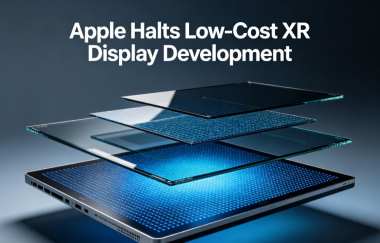
According to display industry sources, Apple has decided to halt development of a lower-cost extended reality (XR) display project that had been considered for a more affordable successor to the Apple Vision Pro.
Sources said on July 8 that Samsung Display has moved to terminate early its display development program for Apple’s XR device, which had originally been scheduled for completion in September. Known in the industry as G-VR, the project focused on developing micro OLED displays based on glass substrates. Mass production had been targeted for after 2028, but the program has now been canceled.
The G-VR project was viewed as an evolution of the OLED-on-Silicon (OLEDoS) technology used in Apple Vision Pro. Unlike conventional OLEDoS displays, which fabricate OLED layers on silicon wafers, the G-VR approach placed OLED panels on glass substrates. This design was expected to reduce manufacturing costs significantly while supporting thinner and lighter XR devices.
Industry observers had regarded the glass-substrate micro OLED approach as a suitable display solution for Apple’s proposed lower-cost XR headset. By reducing dependence on silicon wafers, the technology was expected to improve cost efficiency and broaden the commercial viability of future XR products.
Apple Vision Pro launched with a starting price of US$3,499. Reports earlier this year suggested weak market demand and indicated that production and research on the next-generation model had been slowed or suspended. The cancellation of the G-VR project appears to be part of Apple’s broader effort to reassess its XR display strategy.
One industry source stated that work on the project had effectively entered its final stage earlier this year, with Samsung Display planning to formally close the program in September. Another source said that as Apple shifts its strategic focus from XR headsets toward AI-powered smart glasses, momentum for developing glass-substrate VR displays has diminished.
For electronic components readers, the development highlights the challenges associated with balancing performance, manufacturing cost, and device form factor in next-generation XR display technologies. It also signals potential changes in demand for micro OLED display components, glass-substrate technologies, and related XR hardware development.


