
Bosch Starts U.S. Chip Plant Trial Production


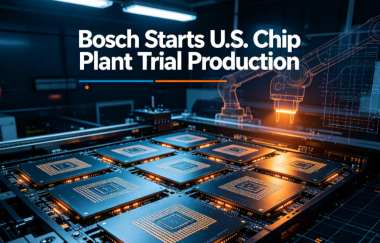
According to Bosch, the German automotive technology and semiconductor manufacturer has started pilot production of semiconductor samples at its first chip manufacturing facility in the United States and finalized a $225 million funding agreement with the U.S. Department of Commerce to strengthen domestic silicon carbide (SiC) chip production capabilities.
Located in Roseville, California, the facility was acquired by Bosch from TSI Semiconductors in 2023 and is undergoing a major transformation into an advanced semiconductor manufacturing site. Including funding from the U.S. government, the project represents a total investment of approximately $2 billion and is expected to begin commercial production later this year.
Paul Thomas, president and CEO of Bosch North America, said that the United States-Mexico-Canada Agreement (USMCA) is one of the factors driving Bosch’s increased investment in U.S. semiconductor manufacturing. As companies seek to build more resilient local supply chains, automakers are increasingly looking to work with partners that can provide stable and reliable chip supplies closer to their production facilities.
The $225 million funding comes from the U.S. Department of Commerce’s CHIPS Program Office, which was established under the 2022 CHIPS and Science Act. The program aims to expand domestic semiconductor manufacturing capacity in the United States and reduce reliance on overseas supply chains.
Unlike chips used for in-vehicle infotainment systems or advanced driver assistance systems (ADAS), silicon carbide semiconductors are primarily designed for high-voltage power management applications. In electric vehicles (EVs), SiC chips improve power conversion efficiency between the battery and electric motor, helping reduce heat generation and energy losses while enhancing driving range and charging performance.
Beyond automotive applications, silicon carbide technology is also gaining attention in areas such as data centers and power infrastructure. Thomas noted that although electric vehicle sales growth has been slower than initially expected, continued demand from hybrid vehicles and defense applications supports the long-term value of Bosch’s semiconductor investment.
Bosch also announced plans to further expand its U.S. operations, with investments of up to $7.5 billion expected through 2031. The company aims to strengthen its presence in advanced semiconductor manufacturing while supporting the development of a more localized and resilient chip supply chain in North America.


