
SpaceX-Tesla Terafab Chip Plant Begins $16.8B Build


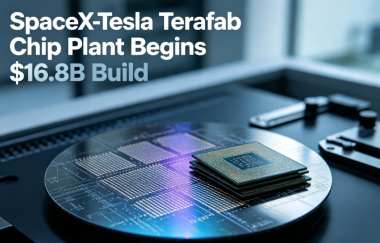
According to SpaceX’s official announcement on August 6, Elon Musk’s Terafab superchip manufacturing project has reached a major milestone, with construction officially beginning in Grimes County, Texas. The initial investment for the facility is estimated at $16.8 billion, with total spending expected to increase significantly during future expansion phases.
The Terafab project aims to become a large-scale AI chip manufacturing hub capable of producing 1 terawatt (1,000 gigawatts) of AI computing capacity annually. The planned facility will cover more than 100 million square feet (approximately 9.3 million square meters) and is designed to integrate advanced logic chip manufacturing, memory production, semiconductor packaging, and testing within a single campus.
SpaceX stated that chips produced at Terafab will support a range of AI-driven applications, including Tesla’s Optimus humanoid robots, Cybercab autonomous vehicles, and SpaceX’s space-based data centers. Musk previously revealed that around 25% of Terafab’s future AI computing capacity will be allocated to Tesla’s Optimus robots, while the remaining 75% will support AI spacecraft development.
Beyond logic processors, Terafab is also expanding into memory technology. Tesla has recently posted recruitment openings for memory process integration engineers to develop DRAM-related technologies, including memory cell structures, capacitor designs, full manufacturing process development, and high-volume manufacturing (HVM) preparation.
The job descriptions indicate that Terafab may explore advanced DRAM nodes as well as emerging memory technologies such as MRAM, RRAM, and 3D DRAM. This move suggests that the project could eventually compete with established memory manufacturers, including Samsung Electronics, SK hynix, and Micron, in the rapidly growing AI memory market.
Terafab is being jointly developed by Tesla and SpaceX, with a goal of creating a highly vertically integrated semiconductor ecosystem that combines chip design, wafer fabrication, advanced packaging, and testing within one platform. The strategy is expected to reduce AI chip development cycles and improve supply chain control.
The project is still in its early construction stage. SpaceX previously indicated that Terafab’s total investment could eventually reach $119 billion, potentially making it one of the world’s largest semiconductor manufacturing facilities and a major force in the future AI chip industry.


