
Samsung Puts Half of 4nm Capacity Into HBM4


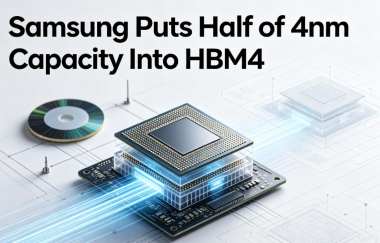
According to reports from South Korean media, Samsung Electronics is significantly increasing its focus on HBM4 production as demand for high-bandwidth memory continues to rise with the growth of artificial intelligence.
Samsung’s foundry business is reportedly allocating around 50% to 60% of its 4nm capacity to manufacturing HBM4 base dies. The company is using its SF4 process for these base dies, with production mainly taking place at the S5 and S6 lines within its Pyeongtaek facilities. Samsung’s 4nm lines are reportedly operating close to full capacity, with a large portion dedicated to HBM4 base-die production.
HBM4 base dies are becoming increasingly important as they can integrate additional logic functions, including memory controllers and PHY interfaces. This allows some circuitry traditionally placed on AI processors to be moved into the HBM base die, potentially reducing chip area and improving overall system design efficiency.
The demand for customized HBM4 is also growing as major cloud companies develop their own AI accelerators and ASICs. Samsung’s combination of memory, foundry, and advanced packaging capabilities could give it an advantage in developing customized HBM solutions.
Samsung’s HBM market share has also increased significantly. In the second quarter of 2026, its revenue-based HBM market share reportedly reached 38%, up from about 15% a year earlier, while SK hynix’s share declined from 64% to 50%.
Samsung has already begun providing HBM4 samples to customers and plans to expand shipments in the second half of 2026. The company expects HBM4 revenue to grow more than threefold in the third quarter compared with the previous quarter.
The increased allocation of advanced 4nm capacity highlights Samsung’s strong focus on the HBM4 market. As next-generation AI platforms and customized AI chips move toward mass production, HBM4 could become an increasingly important growth area for the semiconductor industry.


