
Samsung Display Plans RGB OLEDoS Mass Production


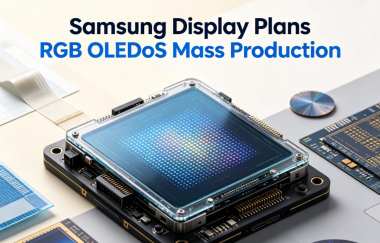
According to industry sources, Samsung Display plans to invest approximately KRW 300 billion (about $210 million) to establish mass production of red, green, and blue (RGB) silicon-based OLED displays, also known as OLED on Silicon (OLEDoS).
Industry insiders said on September 15 that Samsung Display is expected to hold an investment review committee meeting later this month to finalize its investment plan for the mass production of 12-inch RGB OLEDoS panels. The proposed production line is expected to have a monthly capacity of approximately 3,000 wafers, with the total investment estimated at around KRW 300 billion.
Earlier this year, Samsung Display evaluated 12-inch RGB OLEDoS deposition systems from South Korea's Sunic System and Japan's Canon Tokki. After considering equipment performance and previous delivery experience, Samsung Display selected Sunic System for the project. The deposition equipment supplied by Sunic System is expected to cost approximately KRW 150 billion, around three times the KRW 40 billion to KRW 50 billion typically associated with conventional OLEDoS deposition equipment.
The equipment order is expected to be placed in the fourth quarter. If the investment plan receives approval, Samsung Display will finalize detailed equipment specifications, delivery schedules, and acceptance criteria before signing the purchase agreement.
Samsung Display is reportedly considering installing the equipment in 2027 and beginning mass production of RGB OLEDoS in 2028. From equipment manufacturing and installation to commissioning and process stabilization, the entire process is expected to take more than one year.
OLEDoS is a microdisplay technology in which OLED emissive layers are formed directly on silicon wafers. Based on the method used to generate color, OLEDoS can generally be divided into white OLED on silicon (WOLEDoS) and RGB OLEDoS.
WOLEDoS generates RGB colors by placing a color filter over a white OLED emissive layer. Because organic materials do not need to be separately deposited for each subpixel, the deposition process and mask-alignment requirements are relatively less demanding. Its manufacturing processes and supply chain have also become increasingly established, and the technology has already been adopted in commercial extended reality (XR) devices, including Apple's Vision Pro.
However, white OLED light loses part of its intensity when passing through a color filter. Increasing display brightness therefore requires more power, which can lead to greater heat generation and reduced battery life.
RGB OLEDoS takes a different approach by directly depositing red, green, and blue emissive materials onto their respective subpixels. By eliminating the need for a color filter, the technology can reduce optical losses and potentially provide advantages in display brightness, light-emitting efficiency, and color reproduction.
The planned investment reflects Samsung Display's efforts to advance RGB OLEDoS manufacturing and prepare for potential growth in high-resolution microdisplay applications, particularly in XR devices.


