
Mature-Node Chips Face Price Hikes


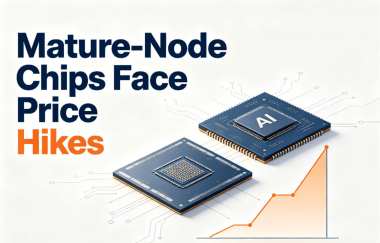
According to industry analysis, strong demand for advanced semiconductor processes driven by artificial intelligence (AI) is also boosting demand for mature-node chips, including power management ICs (PMICs), microcontrollers (MCUs), sensors, and MOSFETs. As Taiwan Semiconductor Manufacturing Co. (TSMC) gradually reduces its focus on certain mature-node processes, some orders are shifting to United Microelectronics Corp. (UMC), Powerchip Semiconductor Manufacturing Corp. (PSMC), Vanguard International Semiconductor Corp. (VIS), and other foundries. As a result, capacity utilization is rising and supply is becoming increasingly tight. UMC has indicated that foundry prices could see more noticeable increases, while PSMC is reportedly considering significant price adjustments.
Industry analysts said the recovery in mature-node semiconductor demand is not simply the result of inventory replenishment in consumer electronics such as smartphones and notebooks. Instead, it reflects a more structural increase in demand associated with AI infrastructure. High-performance computing (HPC) chips require large numbers of supporting power management, control, sensing, and power semiconductor components.
AI servers are particularly important to this trend. As server power consumption and operating voltages continue to rise, the demand for related semiconductor components is increasing in both volume and performance requirements. This has rapidly shifted 8-inch and 12-inch mature-node wafer capacity from a previous period of oversupply toward tighter supply conditions.
UMC and PSMC have both confirmed that recent order activity has been positive. UMC has indicated that if current supply-demand trends continue, the scale and scope of foundry price adjustments next year could be more significant than those seen in the second half of this year, pointing to potentially broader pricing changes in 2027.
UMC expects wafer shipments this quarter to increase by a high-single-digit percentage from the previous quarter, with capacity utilization exceeding 90% and gross margin remaining in the mid-30% range. Its 8-inch business is benefiting from stronger demand for power management ICs, sensors, and MCUs, while utilization of its 12-inch capacity is also expected to remain healthy. The company has emphasized that it will maintain pricing and margin discipline rather than sacrifice profitability to pursue market share.
Market reports have also suggested that PSMC is preparing to raise foundry prices as both memory and logic manufacturing capacity become tighter, with increases for some products reportedly potentially reaching 40%. PSMC has declined to comment on the market reports but confirmed that customer demand is currently strong.
PSMC is benefiting from improving conditions in both memory and mature-node foundry markets. As prices for specialty DRAM recover, orders for logic products such as power management chips used in AI servers are also increasing. PSMC reported consolidated revenue of NT$7.009 billion in August, its highest level in nearly 50 months. Industry observers noted that the company's efforts in recent years to optimize its product mix and reduce lower-margin orders could give it greater flexibility to renegotiate prices as supply and demand conditions improve.
VIS is also expected to benefit from the shift in mature-node foundry demand. As TSMC continues to prioritize advanced processes and gradually reduces certain mature-node production activities, VIS could receive some of the resulting orders. The company has long focused on power management ICs, display driver ICs, and automotive semiconductors, giving it complementary process capabilities and customer requirements.
With AI server deployments driving higher demand for power management and power semiconductor components, VIS could see stronger capacity utilization. An improved product mix could also support higher average selling prices and potentially improve gross margins.
Overall, the AI-driven semiconductor expansion is extending beyond advanced processors to a broad range of mature-node components. Rising demand for PMICs, MCUs, sensors, MOSFETs, and other supporting devices is tightening mature-node capacity and increasing the potential for foundry price adjustments across the semiconductor industry.


