
Intel Shifts 1.8nm CPU Capacity to 7nm Xeon Chips


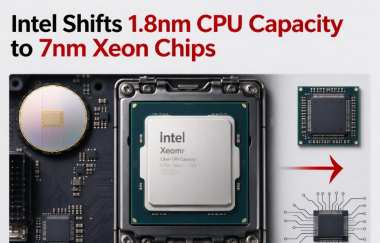
According to Intel, the company is expanding its manufacturing and advanced packaging capacity to meet surging demand for data center CPUs driven by artificial intelligence (AI), despite continued weakness in the consumer PC market. Intel plans to shift some production resources from client processors to server CPUs, expand its Fab 24 facility in Ireland, accelerate equipment installation at Fab 62 in Arizona, and increase advanced packaging capacity in New Mexico and Malaysia.
Demand for Intel Xeon server processors continues to exceed supply. In the third quarter of 2026, Intel's Data Center and AI (DCAI) business generated $7.3 billion in revenue, up 17% quarter over quarter and nearly 80% year over year. The company expects strong demand for data center CPUs through 2027 and 2028, as AI infrastructure increasingly relies on CPUs for agentic AI and inference workloads.
To increase output, Intel is prioritizing production of its Xeon 6 "Granite Rapids" processors based on the Intel 3 process. The company is expanding its Fab 24 manufacturing operations in Ireland, although the additional capacity is not expected to become operational until late 2027. Intel also plans to redirect some manufacturing resources in Oregon from Intel 18A to Intel 3, with the new capacity expected to come online in the second half of 2027.
Meanwhile, Intel is accelerating its advanced manufacturing development in Arizona. Fab 52 is ramping up Intel 18A production, while equipment installation at Fab 62 is being brought forward. The facility will become Intel's second high-volume manufacturing site for Intel 18A, 18A-P and related process technologies, supporting future processors such as Diamond Rapids and Nova Lake.
Beyond wafer production, Intel is also addressing shortages of advanced organic substrates and advanced packaging capacity. The company is working with substrate manufacturers to increase supply, with approximately 40% additional substrate capacity expected to become available by the second half of 2027. It is also expanding advanced packaging operations in New Mexico and Malaysia to support multi-chip processors using technologies such as EMIB, EMIB-T, Foveros 3D and hybrid bonding.
Intel expects capital expenditure to reach approximately $20 billion in 2026, with a significant increase in 2027. Its confirmed purchase orders for semiconductor manufacturing equipment have risen nearly 40% quarter over quarter as the company secures the tools needed for expansion.
Despite these investments, Intel expects supply constraints to remain particularly severe through the first half of 2027, as new equipment installation, wafer production cycles and substrate capacity expansion take time. However, the company believes that increased manufacturing output, improved yields and greater advanced packaging capacity will help it capture growing AI infrastructure demand in the second half of 2027 and beyond.


