
Musk May Let TSMC Run Texas Terafab


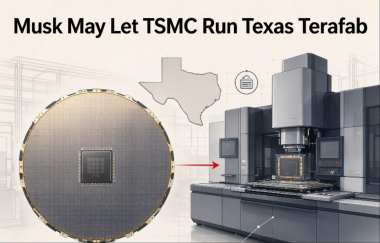
According to supply chain sources, Elon Musk is reconsidering the partnership structure with Taiwan Semiconductor Manufacturing Company (TSMC) for the Terafab project in Texas, potentially moving away from his original plan to independently build and operate a semiconductor fabrication facility.
Musk had initially sought to maintain control over fab construction and operations, while considering leasing part of the proposed facility to TSMC. However, reports indicate that his position has softened, with both sides preparing to resume negotiations.
The shift reportedly follows slower-than-expected progress in several areas of Terafab, including advanced packaging, printed circuit board (PCB) production, chip manufacturing yields, and construction schedules. These challenges have prompted Musk to reassess the feasibility of building an independent semiconductor manufacturing ecosystem.
TSMC Chairman and CEO C.C. Wei recently confirmed that the company had been in contact with the Terafab team, emphasizing that TSMC would need to retain operational control of any fab it manages. Under the potential revised arrangement, TSMC could take primary responsibility for fab construction and operations, although ownership and investment structures remain under discussion.
Manufacturing Challenges Drive Strategic Shift
Terafab is intended to support semiconductor development and production for Tesla's autonomous driving systems, Optimus humanoid robots, and SpaceX-related operations. Musk has outlined ambitious goals for the project, including designing, manufacturing, and testing 10 chips annually.
However, progress in fan-out panel-level packaging (FOPLP), PCB capacity, and chip manufacturing yields has reportedly fallen behind expectations. Building these capabilities from scratch would require substantial investment, specialized expertise, and time.
TSMC's decades of experience in wafer fabrication, process integration, yield optimization, and high-volume manufacturing could help address these challenges and accelerate Terafab's development.
Musk has acknowledged that semiconductor manufacturing is among the world's most difficult engineering challenges and that he still has much to learn about the industry. Although he hopes to eventually develop specialized manufacturing equipment and improve factory automation, cooperation with an established foundry could provide a more practical path forward.
Investment and Technology Protection Remain Key Issues
A partnership with TSMC could accelerate wafer production and provide a more reliable chip supply for Musk's businesses. However, several commercial and technical issues must be resolved, including fab ownership, capital expenditure allocation, equipment investment, production commitments, and capacity distribution.
TSMC would also need to protect its proprietary process technologies, manufacturing parameters, yield data, and customer information. Retaining operational control would therefore be a critical condition for its participation.
Long-term purchase commitments from Musk's companies could also help ensure stable fab utilization and make the investment commercially viable.
Texas Expansion Adds Another Dimension to TSMC's US Strategy
Separately, TSMC is evaluating potential expansion opportunities in Texas. Wei confirmed that the company had sent a team to assess possible sites following requests from US customers and assistance from the US government. However, no specific expansion plan has been finalized.
The availability of suitable land, electricity, water, industrial infrastructure, and supporting facilities will be essential to any new fab project. Texas could become another important location in TSMC's US manufacturing strategy, potentially increasing competition with Arizona for future semiconductor investment.
Building an advanced 3nm or 2nm wafer fab can require an estimated $15 billion to $25 billion, while a larger multi-fab manufacturing complex could cost more than $40 billion. Construction and production ramp-up may also take longer in the United States due to infrastructure and workforce challenges.
For Terafab, leveraging TSMC's established manufacturing capabilities may be more practical than independently developing an entire semiconductor production ecosystem. The outcome of the renewed negotiations will largely depend on operational control, investment responsibilities, intellectual property protection, and long-term production commitments.


