
NXP Launches Unified Robotics Platform for Physical AI


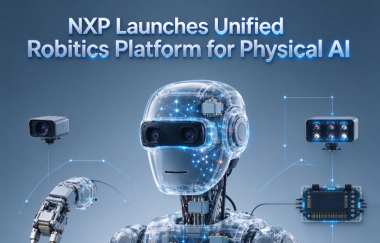
According to NXP Semiconductors N.V. (NASDAQ: NXPI), the company announced on November 9, 2026, the launch of its new Unified Robotics Platform, designed to accelerate the development and deployment of trusted physical AI systems. Built on NXP's Neural Axis architecture, the platform connects sensing, real-time control, AI inference, and communication through a secure, distributed framework.
The platform combines hardware and software into an integrated ecosystem featuring both cybersecurity and functional safety capabilities. It provides developers with a unified development environment, software development kits (SDKs), and validated reference designs, helping reduce system integration and testing time from months to days or weeks.
By integrating pre-tested software and interoperable robotic subsystems, the platform allows developers to start with individual functions, such as motor control, and gradually expand to more advanced capabilities, including AI perception, flight control, and navigation. This approach is expected to simplify the development of autonomous drones and other intelligent robotic systems.
The initial reference designs focus on drone applications and include the NavQ95 based on the i.MX 95 application processor for autonomous computing and flight control; the Tropic VMU/FMU based on the i.MX RT1064 crossover MCU for flight management; a 100Base-T1 Sensor Node powered by the MCX N947 MCU for smart sensor networking; and an AM32-compatible flight controller based on the MCX A13 MCU for motor control. Supported by the unified robotics SDK, these designs enable developers to achieve initial drone functionality in as little as 30 minutes.
The platform also integrates established open-source technologies, including PX4, Zephyr, and ROS 2, providing reusable software components, middleware integration, drivers, configuration tools, and reference applications. Its modular architecture is designed to support future applications beyond drones, including service robots, autonomous mobile robots (AMRs), and other AI-powered autonomous systems.
NXP stated that the Unified Robotics Platform is now available, with drone reference designs and the accompanying SDK ready for developers. Additional support for other autonomous systems is expected in the second half of 2027.


