
NVIDIA AI GPU Lead Times Surge, B300 Delays Reach 40 Weeks


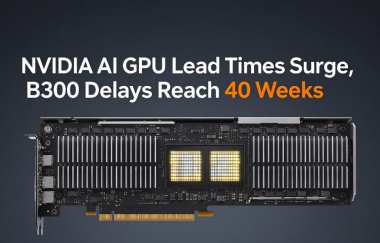
According to Taiwanese media reports on November 25, NVIDIA's AI product supply remains tight, with delivery lead times for new orders of its B300 and GB300 GPUs increasing significantly. Sources in its manufacturing supply chain indicate that even workstation-class superchip systems now face lead times of approximately 26 weeks. The capacity shift toward AI products is also putting pressure on consumer graphics card supplies, prompting NVIDIA to reduce shipments of its GeForce RTX 50 series GPUs. The transition to the next-generation RTX 60 series may also be delayed.
NVIDIA's major manufacturing partners have increasingly prioritized production of the B300 and GB300 platforms, as well as the gradual ramp-up of its Vera Rubin platform. Meanwhile, shipments of the RTX Pro series AI servers and workstations, DGX Station desktop AI workstations, and RTX Spark AI PCs remain largely on schedule, with no significant delivery disruptions reported.
However, lead times for new orders have increased considerably. The B300 GPU reportedly has a delivery window of 26 to 40 weeks, while the GB300 takes approximately 14 to 26 weeks. The desktop GB300 superchip system used in DGX Station workstations faces a lead time of around 26 weeks. GPU accelerator cards for RTX Pro servers and workstations also have delivery times exceeding 26 weeks. As a result, many orders placed over the past two quarters are not expected to be fulfilled until the second or third quarter of 2027.
The supply chain is also facing memory-related constraints. Memory manufacturers are prioritizing advanced production capacity for server DRAM, limiting the availability of GDDR7 memory used in graphics cards. GDDR7 prices continue to rise, adding to production costs. Meanwhile, higher PC prices have weakened demand in Asian and European markets, while finished PC inventory has increased across North American sales channels. Some PC manufacturers are reportedly reassessing their memory procurement plans for the first quarter of 2027.
NVIDIA's RTX 60 series was initially targeted for mass production by the end of 2027, but its launch schedule may now be pushed back. NVIDIA previously stated that GeForce demand remains strong and that its graphics cards continue to ship, while acknowledging ongoing memory supply constraints. If the next-generation lineup is delayed, graphics card manufacturers may need to rely on the RTX 50 series for longer to support sales. Semiconductor industry observers believe that wafer capacity originally allocated to consumer graphics GPUs could instead be redirected toward data center processors.
On November 17, NVIDIA announced an expansion of its long-term supply agreements. Its Vera Rubin NVL72 systems and Vera CPUs began ramping up shipments in the third quarter, relying on TSMC's 3nm and 5nm process technologies and CoWoS advanced packaging. However, actual future supply allocations remain uncertain. If emerging cloud service providers delay data center expansion projects due to financing constraints, additional GPU orders could also fluctuate.
In addition, NVIDIA's board of directors has strengthened oversight of national security and export compliance. Whether this will affect the pace of introducing new products into regulated markets remains to be seen.


