
Samsung to Cut HBM3E, Shift 40% 1a DRAM to Standard DRAM


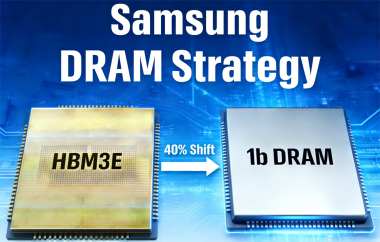
According to South Korean media DealSite, Samsung Electronics is planning a significant reduction in its fourth-generation (1a) DRAM-based HBM3E production next year to maximize profits, shifting focus toward fifth-generation (1b) DRAM for standard products, which offer higher margins. Despite a redesign, 1a DRAM utilization remains relatively low, prompting the company to consider cutting output. An internal source revealed that Samsung is discussing converting 30–40% of 1a DRAM capacity to 1b DRAM, and factoring in investments in mature process lines like 1z could add an extra 80,000 wafers of 1b DRAM capacity per month.
Currently, Samsung's HBM3 and HBM3E products are based on 1a nm DRAM, while 1b DRAM is used for standard memory products such as DDR5, LPDDR5X, and GDDR7. Upcoming HBM4 production will rely on 1c and 1b nm DRAM processes. With AI-driven demand, limited DRAM expansion, and HBM consuming standard DRAM capacity, 1b DRAM-based products are in high demand, pushing prices higher. Reducing HBM3E output allows Samsung to expand standard DRAM production and boost profitability.
Over the past years, the profit gap between Samsung and SK Hynix has widened. Last year, Samsung's semiconductor unit posted operating profits of 15.1 trillion KRW, while SK Hynix reached 23.467 trillion KRW. Samsung's expected operating profit this year is 23.6 trillion KRW, still far below SK Hynix's 43 trillion KRW. During the 2023 semiconductor downturn, Samsung's semiconductor division recorded a 14.8795 trillion KRW loss, nearly double SK Hynix's 7.7303 trillion KRW.
Samsung's 12-layer HBM3E yields have improved, with projected operating margins around 30%. However, high demand and rising prices for DDR5 and other standard DRAM products could push margins above 60%, making standard DRAM far more profitable. Industry sources also predict that HBM3E prices will drop over 30% on average next year, further favoring the shift to 1b DRAM production.
Although Samsung joined NVIDIA's HBM3E supply chain in the second half of this year, its supply remains limited, as NVIDIA already sources enough from SK Hynix and Micron, with plans to transition mainly to HBM4 next year. AMD is also expected to adopt HBM4 primarily starting next year. Besides NVIDIA and AMD, Samsung supplies HBM3E to major tech companies like Broadcom and Google, and reduced production may impact them. However, insiders suggest that if Micron’s HBM4 redesign reduces competitiveness, other ASIC clients could gain more HBM3E capacity from Micron next year.
Samsung remains cautious with HBM4 investments, planning to increase 1c DRAM production from 20,000 to 80,000 wafers per month and upgrade existing mature lines to 1c DRAM, targeting a total 1c DRAM capacity of 150,000 wafers by year-end. Rumors suggest the company may consider scaling back investments. Additionally, Samsung recently decided to convert part of its Pyeongtaek and Hwaseong NAND flash lines into standard DRAM lines, a strategic move aimed at capitalizing on longer-lasting price increases in standard DRAM compared with NAND flash.


