
GTO vs SCR: Why Can GTO Turn Itself Off?


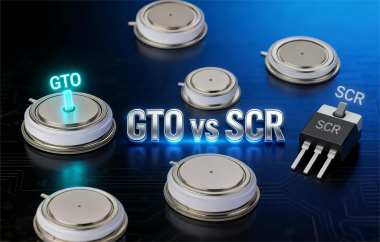
In the field of power electronics, controlling high-voltage and high-current switching often relies on thyristor devices. While conventional thyristors (SCRs) are mature and reliable, once triggered into the on-state, they cannot be actively turned off via the gate terminal. They can only reset when the circuit current naturally drops below the holding current or when the circuit voltage reverses. This characteristic limits their application in DC circuits or high-frequency conversion systems (such as inverters and choppers) that require switching at any time and flexible control. To address this limitation, the GTO emerged—a type of thyristor that can be triggered on via the gate and also actively turned off via the gate. The advent of GTOs has made thyristors more flexible and controllable in modern power conversion systems.
Catalog
II. Main Reasons Why GTOs Achieve Self-Turn-Off
III. Why Can't Conventional Thyristors Turn Themselves Off?
I. What is a GTO Thyristor?
A GTO (Gate Turn-Off Thyristor) is a high-power thyristor whose structure—like that of a conventional SCR—is based on a four-layer PNPN semiconductor with three terminals (anode, cathode, gate). However, unlike an SCR, the gate of a GTO is not only used to trigger turn-on but can also be used for active turn-off. Specifically, a positive gate current pulse is applied to turn it on; when conduction needs to be stopped, a negative pulse can be applied to the gate to turn it off. This “fully controllable” capability allows the GTO to achieve turn-off without relying on external commutation circuits or waiting for the current to naturally fall to zero.
In terms of internal structure, the GTO achieves reliable turn-off capability through optimization of P/N doping, layer thicknesses, and the contact region between the gate and cathode within its four-layer PNPN design. To ensure reliable turn-off, the gate-cathode contact in a GTO is typically designed as an interdigitated structure, meaning there are numerous small cells interleaved between the gate and cathode. This allows the entire device to respond more uniformly during turn-off. This structural improvement is the foundation that enables the GTO’s gate turn-off capability.
II. Main Reasons Why GTOs Achieve Self-Turn-Off
First, GTOs adopt a segmented cathode and integrated gate structure. The cathode is divided into numerous small cathode cells arranged in an interdigitated pattern around the gate. This reduces the lateral resistance between the gate and cathode and significantly enhances the gate region’s control capability. During the turn-off process, when a negative voltage is applied to the gate, it can effectively extract stored charge from the cathode region, weakening the injection efficiency of the PN junctions and thereby breaking the internal positive feedback condition.
Second, by precisely controlling the carrier lifetime and doping distribution in each semiconductor layer, GTOs reduce the recombination time of minority carriers during turn-off. This enables the anode current to quickly transfer from all cathode cells to the gate circuit during turn-off, forming a sufficiently large negative gate current (typically one-third to one-fifth of the anode current), which “pulls” the main current apart. This design gives the gate the ability to extract carriers, whereas the gate structure in conventional thyristors is simple and cannot form an effective carrier extraction path once conduction begins.
Finally, the turn-off mechanism of GTOs relies on a strong drive turn-off signal. During turn-off, a negative gate current pulse with sufficient amplitude and steepness is required to quickly remove the large amount of charge stored in the four-layer structure during conduction, allowing the device to exit saturation. In contrast, the gate of a conventional thyristor is only used for triggering and lacks the ability to provide a strong negative pulse to interrupt the positive feedback, thus making self-turn-off impossible.
III. Why Can't Conventional Thyristors Turn Themselves Off?
The working principle of a conventional thyristor is based on a two-transistor model, which can be viewed as the interconnection of a P-N-P transistor and an N-P-N transistor. When a forward trigger current is applied to the gate, the two transistors form a positive feedback loop, and the device rapidly enters saturation and conducts. Once conduction begins, even if the gate signal is removed, the positive feedback sustains itself, rendering the gate ineffective for control. To turn it off, the anode current must be reduced below the holding current, usually requiring an external commutation circuit to force the current to reverse or interrupt. This “trigger-on, natural-turn-off” characteristic allows it to turn off automatically at voltage zero-crossings in AC circuits, but makes turn-off difficult in DC circuits.
IV. Conclusion
In summary, although GTOs and conventional SCRs both belong to the thyristor family and are four-layer PNPN, three-terminal (anode, cathode, gate) devices, they differ fundamentally in terms of controllability. The gate of a conventional SCR can only trigger turn-on; its turn-off must rely on natural current reduction, commutation circuits, or voltage reversal. In contrast, through structural and physical mechanism optimizations, GTOs allow the gate to retain control over internal carriers even after conduction—by using a negative pulse to extract carriers and disrupt the internal regenerative mechanism, enabling active turn-off at any time via the gate. This controllable turn-off capability has made GTOs important devices in fields such as DC conversion, inverters, high-power switching power supplies, choppers, and electric traction.
It is worth noting, however, that the design, gate driving, and turn-off process of GTOs impose higher engineering demands. For example, sufficiently strong negative gate current and appropriate snubber circuit design are required to avoid issues during turn-off such as tail current, current filamentation, overheating, or device damage. Therefore, practical design and application must comprehensively consider device characteristics, drive capability, thermal management, and circuit protection.


