
Which MOSFET Breakdowns Do You Know?


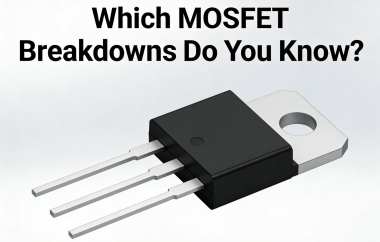
In modern electronics and power circuit design, the MOSFET (commonly called a "MOS transistor") is one of the most important switching and control devices. It is widely used in switch-mode power supplies, motor drives, DC-DC converters, power management, and other areas thanks to its advantages like high input impedance, low control power consumption, and fast switching capability. At the same time, the reliability of MOSFETs—particularly their breakdown or failure mechanisms—remains a critical concern for engineers, designers, and procurement specialists. This article will introduce the basic definition and operating principles of a MOSFET, then focus on analyzing three typical types of breakdown.
Catalog
III. What are the Types of MOSFET Breakdown?
I. What is a MOSFET?
MOSFET stands for Metal-Oxide-Semiconductor Field-Effect Transistor. It is a device that uses an insulated gate to control whether a semiconductor channel conducts current. Its basic structure consists of three layers: the metal (Gate), the oxide (typically silicon dioxide or a high-k material) that serves as the gate insulating layer, and the semiconductor that forms the Source (S), Drain (D), and the bulk or substrate region.
II. How Does a MOSFET Work?
The operation of a MOSFET is based on the field effect. During operation, a voltage applied between the Gate (G) and Source (S) alters the electric field in the semiconductor beneath the channel, enabling the channel to conduct. This allows current to flow between the Drain (D) and Source (S). Compared to traditional Bipolar Junction Transistors (BJTs), MOSFETs are voltage-controlled devices, not current-controlled. This gives them the advantages of high input impedance, low gate drive power, and fast switching speeds.
Because its structure includes a thin gate oxide layer and semiconductor PN junctions (drain/bulk, source/bulk), a MOSFET can experience breakdown or failure under certain extreme conditions. These conditions include excessive voltage, high temperature, energy surges, manufacturing defects, or improper use, even outside its normal on and off states.
III. What are the Types of MOSFET Breakdown?
Regarding Drain voltage breakdown, from the device structure perspective, there are three primary leakage paths: Drain to Source, Drain to Bulk, and Drain to Gate.
1. Drain → Source (Punch-Through Breakdown)
In some MOSFETs, if the drift region doping concentration is too low or the drift region is too thin, the depletion region of the reverse-biased PN junction between the Drain and the Body/Bulk expands when voltage is applied. If this expansion is extensive enough to reach the Source region, a conductive path can form between the Source and Drain even without an applied gate voltage to form a channel. This phenomenon is called punch-through or reach-through (a specific case of punch-through).
Characteristics of punch-through breakdown include:
(1) It exhibits soft breakdown characteristics, meaning the current increases gradually during the breakdown process due to the wide depletion layer. Furthermore, a wide depletion layer is prone to the Drain-Induced Barrier Lowering (DIBL) effect, which can forward-bias the source-substrate junction, leading to a progressive increase in current.
(2) The soft breakdown point occurs when the depletion layers from the source and drain connect. At this point, carriers injected from the source into the depletion layer are accelerated by the electric field to the drain. Thus, punch-through breakdown also shows a point of sharp current increase. However, this sharp increase differs from that in avalanche breakdown. Here, the current resembles that of a forward-biased source-substrate PN junction, whereas avalanche breakdown current is primarily the avalanche current from a reverse-biased PN junction breakdown, which can be much larger if not limited.
(3) Punch-through breakdown is generally non-destructive because the electric field strength does not reach the level required for avalanche breakdown, thus not generating a large number of electron-hole pairs.
(4) Punch-through breakdown typically occurs within the body of the channel, not at the surface. This is mainly because channel implantation creates a higher surface concentration. Therefore, NMOS transistors usually incorporate anti-punch-through implantation.
(5) Generally, the doping concentration at the bird's beak edge is higher than in the middle of the channel, so punch-through breakdown usually happens in the middle of the channel.
(6) Poly gate length affects punch-through breakdown voltage, which increases with longer gate lengths. For avalanche breakdown, there is also an effect, but it is less pronounced.
2. Drain → Bulk (Avalanche Breakdown)
Another common breakdown mechanism is avalanche breakdown caused by a reverse-biased PN junction. When the MOSFET is off (gate voltage is zero, channel is not formed) and the voltage applied to the reverse-biased drain-to-bulk PN junction exceeds its rated breakdown voltage (specified as V_DSS or BVDSS), the electric field in the depletion region becomes strong enough. High-speed electrons gain sufficient kinetic energy to collide with the lattice, creating electron-hole pairs. These newly generated carriers are in turn accelerated by the electric field, leading to further collisions. This cascading multiplication process causes a rapid, exponential increase in carrier count, resulting in a surge of current between the drain and source, putting the MOSFET into a breakdown state.
If this breakdown occurs and the device structure, packaging, heat dissipation design are inadequate, or if the energy dissipated (avalanche energy) exceeds the safe limit, it can cause a rapid temperature rise, internal damage, or even complete device failure. This is the most common and dangerous type of breakdown in power MOSFETs.
Consequently, many power MOSFET datasheets specify avalanche capability, maximum single-pulse avalanche energy (E_AS), and the corresponding maximum current (I_AS). These ratings remind designers to include sufficient safety margins during component selection and circuit design.
3. Drain → Gate Breakdown
Apart from the breakdowns related to source-drain or drain-bulk paths, there is also a breakdown mechanism involving the Gate, namely Drain-to-Gate breakdown (which often includes gate-oxide breakdown). Under certain structural conditions, extreme drain voltages, or improper use, a strong electric field may develop between the Drain and Gate (e.g., due to drain-gate overlap, superimposed voltages, parasitic capacitance, switching transients, or external surges). If this electric field is too strong, it can compromise the insulating capability of the gate oxide layer, leading to insulation failure between the Gate and the Drain/Source/Bulk. This results in leakage, short circuits, or permanent damage.
The descriptions above primarily cover off-state breakdowns, where the Gate voltage is 0V. However, breakdown can also occur when the device is on (Gate is active) and the Drain voltage is too high. This is referred to as on-state breakdown. This situation is particularly prone to happen at lower Gate voltages, or just as the transistor begins to turn on, and it almost exclusively affects NMOS transistors. Therefore, parameters like BVON are typically tested during Wafer Acceptance Testing (WAT).
It is crucial to note that the test conditions for this are specific. The Gate voltage is not arbitrary; it must be set near the threshold voltage (Vt).
IV. Conclusion
The MOSFET is a fundamental switching and control component in modern electronics, power, and control systems. Its convenience and efficiency are undeniable. However, it is also susceptible to several potential breakdown or failure mechanisms. These include punch-through, avalanche breakdown, gate-related breakdowns (gate-oxide or drain-gate overlap), and long-term issues like Time-Dependent Dielectric Breakdown (TDDB).
Significantly reducing the risk of these breakdown types requires a multifaceted approach. This involves selecting devices with appropriate voltage ratings, optimizing process parameters such as doping profiles, incorporating necessary snubber and clamping protection in circuit designs, and strictly enforcing electrostatic discharge (ESD) protection procedures during production and handling.


