
FET vs. BJT: What's the Difference?


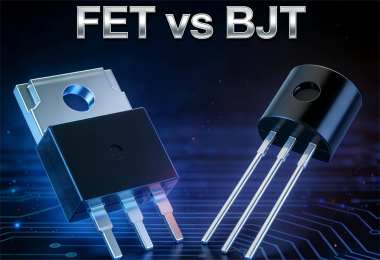
In the world of electronic components, field-effect transistors (FETs) and bipolar junction transistors (BJTs) are undoubtedly two of the most fundamental active devices. Although both can be used to switch currents or amplify signals, they differ significantly in their structure, control mechanisms, charge carrier operations, performance characteristics, and application scenarios. The following will detail what an FET is, what a BJT is, their respective features, and the key distinctions between them.
Catalog
I. What is a Field-Effect Transistor (FET)?
II. What is a Bipolar Junction Transistor (BJT)?
III. Differences Between FETs and BJTs
I. What is a Field-Effect Transistor (FET)?
A Field-Effect Transistor (FET) is a type of transistor primarily controlled by voltage, which uses an electric field to regulate current flow. The most common type is the Metal-Oxide-Semiconductor FET (MOSFET). It consists of three terminals: the Source, the Drain, and the Gate, with a semiconductor channel between them. The Gate is electrically insulated from the channel by a thin insulating layer, typically silicon dioxide. Applying a voltage to the Gate (relative to the Source) creates or eliminates a conductive path within the channel, thereby controlling the current flow from Source to Drain. Because the Gate is insulated, it requires almost no input current to control the channel, meaning the FET itself draws minimal input current, resulting in low power consumption.
It operates using only majority charge carriers for conduction, which is why it's also known as a unipolar transistor. As a voltage-controlled semiconductor device, it offers high input resistance (10⁷–10¹⁵ Ω), low noise, low power consumption, a wide dynamic range, ease of integration, no secondary breakdown, and a broad safe operating area. These advantages have made it a strong competitor to bipolar transistors and power transistors.
The Field-Effect Transistor is named for its operation principle: it uses the electric field effect in its input circuit to control the output circuit current. Since it relies solely on majority carriers in the semiconductor for conduction, it is called a unipolar transistor.
Compared to the bipolar transistor, the FET has the following characteristics:
· It is a voltage-controlled device, using the gate-source voltage (VGS) to control the drain current (ID).
· Its control input draws extremely little current, giving it a very high input resistance (10⁷–10¹² Ω).
· It uses majority carriers for conduction, leading to better temperature stability.
· The voltage gain of an amplifier circuit built with FETs is generally lower than that of a circuit built with BJTs.
· FETs have strong resistance to radiation.
· They exhibit low noise because they lack the shot noise caused by the random diffusion of electrons.
II. What is a Bipolar Junction Transistor (BJT)?
The Bipolar Junction Transistor (BJT) is an earlier, widely used type of transistor that controls current using two PN junctions: the emitter-base junction and the collector-base junction. A BJT has three terminals: the Emitter, the Base, and the Collector. The emitter and collector regions use heavily-doped semiconductor material, while the base region is lightly doped and very thin. Based on doping and polarity, BJTs are mainly classified into NPN and PNP types.
Working Principle:
Bipolar transistors can be categorized by material: germanium and silicon. Each material type has two structural forms, NPN and PNP, with silicon NPN and germanium PNP being the most commonly used. (Here, 'N' stands for Negative, referring to N-type semiconductor where phosphorus is added to high-purity silicon, creating free electrons for conduction under voltage. 'P' stands for Positive, where boron is added to silicon, creating a abundance of holes to facilitate conduction.) Apart from different power supply polarities, their working principles are essentially the same.
III. Differences Between FETs and BJTs
Although both FETs and BJTs can amplify and control signals, their underlying mechanisms and characteristics are fundamentally different. The main distinctions are as follows:
· In terms of conduction mechanism and control method, the BJT is a bipolar device, utilizing both majority and minority carriers for conduction. It is a current-controlled device, requiring a certain base drive current. In contrast, the FET is a unipolar device, using only majority carriers, and is a voltage-controlled device where the gate draws virtually no current.
· Their input resistance differs vastly. BJTs have a relatively low input resistance, typically in the range of 10² to 10⁵ Ω, while FETs possess an extremely high input resistance, reaching 10⁷ to 10¹⁵ Ω.
· Regarding performance, FETs generally offer better thermal stability, a lower noise figure, and stronger radiation resistance. BJTs typically have higher transconductance and voltage gain, but their manufacturing process is relatively more complex.
· In circuit application, the Collector (C) and Emitter (E) of a BJT generally cannot be used interchangeably, whereas the Drain (D) and Source (S) of some FET types can be swapped.
The FET is a voltage-controlled component, while the BJT is a current-controlled component. FETs should be chosen when the circuit must draw minimal current from the signal source. BJTs are more suitable when the signal source voltage is low and drawing more current from it is permissible. FETs rely on majority carriers, with only one type of carrier moving within the device. BJTs use both majority and minority carriers. Since majority carrier concentration is less susceptible to external factors, FETs are more appropriate in environments with significant variations. The high input resistance of FETs makes them suitable for applications requiring high input impedance. Their low noise figure makes them ideal for the front-end stages of low-noise amplifiers.
· The BJT is a bipolar device, meaning both holes and free electrons participate in conduction during operation. The FET is a unipolar device, meaning only one type of carrier—either holes or free electrons—participates in conduction.
· The BJT is a current-controlled device; output current exists only when there is input current. The FET is a voltage-controlled device; output current can exist even without input current.
· BJTs have small input impedance, while FETs have large input impedance.
· The source and drain of some FETs can be swapped, but the collector and emitter of a BJT cannot be interchanged.
· The frequency characteristics of FETs are generally not as good as those of BJTs.
· FETs have a low noise figure, making them suitable for the front-end stages of low-noise amplifiers.
· If minimizing signal source current draw is desired, an FET should be selected. Conversely, if higher current draw is acceptable, a BJT may be more suitable.
IV. Conclusion
In summary, although both Field-Effect Transistors and Bipolar Junction Transistors can amplify signals and function as switches, their internal mechanisms and external characteristics are fundamentally different. FETs, with their advantages of voltage control, ultra-high input impedance, and low noise, dominate modern digital integrated circuits and low-power applications. BJTs, with their strong current drive capability and high gain, maintain an important position in classic circuits like analog amplification and power driving. Understanding these specific differences allows us to make more precise and efficient component choices in circuit design based on factors such as signal characteristics, power requirements, and environmental conditions.


