
Do Fuses Blow When a TVS Diode Fails?


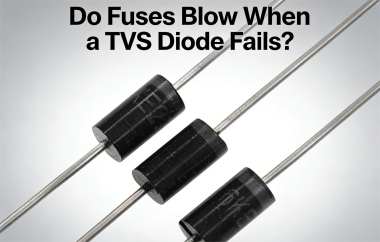
In circuit protection design, fuses and TVS diodes often work side by side: one handles overcurrent protection, while the other focuses on dealing with voltage transients. In real-world applications and failure analysis, many engineers naturally ask a straightforward question: when a TVS diode fails, will the fuse placed in front of it definitely blow? This directly affects whether a fault will escalate and how reliable the protection scheme really is. This article takes a closer look at the different failure modes of TVS diodes and explains in detail how each one impacts the upstream fuse.
Catalog
II. Three major failure modes of TVS diodes
I. What is a TVS diode?
A TVS diode, short for Transient Voltage Suppression Diode, is a protection device used to shield electronic circuits from voltage spikes. When the voltage on the line exceeds its designed breakdown or clamping level, the TVS quickly switches into a low-impedance state and diverts excess energy to ground (or the power return), clamping the voltage to a safe range and protecting downstream components from damage. Compared with traditional MOVs or gas discharge tubes, TVS diodes respond extremely fast and are well suited for high-frequency, fast, and highly destructive transient events.
II. Three major failure modes of TVS diodes
The failure modes of TVS diodes can generally be grouped into three types: short circuit, open circuit, and performance degradation.
1. Short circuit
The first is short-circuit failure, which is also the most common. According to industry references, when a TVS shows extremely low resistance under a very low test voltage, it can be considered shorted. Since a TVS is usually connected in parallel between power and ground, once it shorts, it is essentially shorting the positive and negative rails directly, which results in a very large loop current. According to the ANSI/IEEE C62.35 standard, when the resistance of a TVS diode is less than 1 ohm at 0.1 V DC, it is considered to have failed short-circuit.
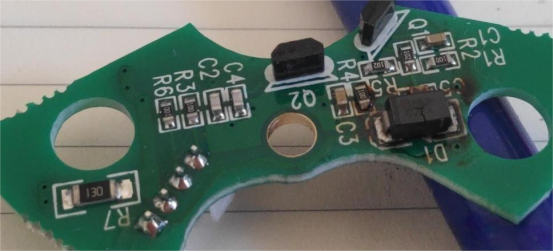
If the fuse rating is lower than or close to this fault current, the fuse will blow quickly and cut off the circuit to prevent further damage. However, if the power source has strong current limiting or the total short-circuit impedance is high enough that the current never reaches the fuse's trip threshold, the fuse may not blow, and this condition can lead to continuous overheating or even a fire hazard.
2. Open circuit
The second is open-circuit failure, which is defined as a case where the breakdown voltage rises far beyond its original value under the specified test current. Unlike the dramatic nature of a short circuit, an open circuit failure is extremely subtle. For bidirectional TVS devices connected in parallel, a simple multimeter is often not enough to judge whether the device is healthy, and dedicated test equipment is usually required. Once a TVS goes open, its protection function is completely lost and the circuit is fully exposed to overvoltage threats, which can easily damage expensive downstream ICs. Since an open circuit does not create an overcurrent path, the upstream fuse will almost never blow as a result, leaving a hidden safety risk in the system.
3. Performance degradation
The third failure mode is performance degradation. In this case, the TVS is neither fully shorted nor completely open, but key parameters such as clamping voltage or leakage current have degraded. For example, the reverse leakage current may increase significantly. This can raise standby or operating power consumption, and in battery-powered devices it may lead to unexpected power drain. Because the current usually remains within the normal operating range and is not high enough to trigger overcurrent protection, the upstream fuse will not blow either, but the system's stability and reliability are quietly reduced.
III. Conclusion
In summary, when a TVS diode fails, the upstream fuse does not necessarily blow. The actual outcome depends entirely on the type of failure and the real operating conditions of the circuit. A short-circuit failure is the most likely to trigger the fuse, while open-circuit and degradation failures tend to happen quietly, leaving the circuit unprotected or only weakly protected. Therefore, during failure analysis, it is important to think in reverse and infer the condition of upstream protection devices based on what is observed downstream. In practical design, beyond proper component selection, multi-layer protection and regular inspection should also be considered to build a more robust circuit protection scheme.


