
Can a Broken-Pin Transistor as a Diode?


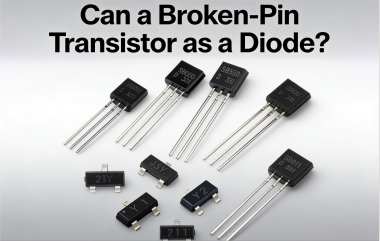
During electronics projects or repairs, have you ever accidentally snapped a pin off a transistor and wondered if it's destined for the trash? Don't be too quick to toss it out—this seemingly broken component might still have some life left in it. Many hobbyists have asked the same question: can a transistor with a broken pin be used as a diode? The answer is yes. This article will break down how to cleverly convert a damaged transistor into a diode. We’ll walk through two practical, proven methods, explain the reasoning behind them, and outline their limitations so you can make the most of what you have on hand in a pinch.
Catalog
II. Can a Transistor with a Broken Pin Be Used as a Diode?
1. Direct Use of Remaining Pins
2. Using an External Component
I. What is a Transistor?
A transistor is a semiconductor device with three pins, typically called the Base, Emitter, and Collector. Its internal structure is formed by alternating P-type and N-type semiconductor materials—specifically an N–P–N structure for NPN types and a P–N–P structure for PNP types. Inside, a transistor contains two PN junctions: one between the Base and Emitter (B–E), and another between the Base and Collector (B–C). By applying a bias voltage to the Base, the transistor can control the current flow between the Emitter and Collector, enabling it to function as an amplifier or a switch. In contrast, a diode has only one PN junction (and two leads). Its primary function is to allow current to flow in one direction only, used for tasks like rectification and circuit protection. Therefore, from a structural standpoint, a transistor inherently "contains" two PN junctions, which creates the possibility of using it as a diode under certain conditions.
II. Can a Transistor with a Broken Pin Be Used as a Diode?
During normal operation, all three terminals of a transistor play distinct roles, with the control signal at the Base being especially crucial. If one pin breaks, that control signal can no longer be properly applied, and the transistor loses its ability to perform amplification or switching functions. This is a fundamental difference from a diode, which only needs its anode and cathode correctly oriented to work.
Nevertheless, with some modifications and experimentation, it is indeed possible to repurpose a transistor missing a pin to function as a diode. Let's look at two detailed methods.
1. Direct Use of Remaining Pins
This is the most straightforward and quickest modification. The core idea is to ignore the transistor's original function and utilize just one of its intact internal PN junctions. For the most common NPN-type transistor, you can choose to use either the Base and Emitter pair or the Base and Collector pair. In practice, you would treat the transistor's Base lead as the diode's anode (positive side) and either the Emitter or Collector as the cathode (negative side). For instance, when you connect the Base and Emitter, you are effectively using the transistor's emitter-base junction. Typically, the PN junction between the Base and Emitter has a relatively stable forward voltage drop, making it behave more like a standard diode, which is why this connection is more widely used for temporary replacements. This method requires no additional components—just solder or connect the two remaining pins. It's perfectly suited for experimental verification or temporary circuit debugging.
2. Using an External Component
This approach is useful when the broken pin is the one you need to use, or when you want to create a specific configuration. It involves using an external standard diode to functionally replace the missing part. For instance, if the Base pin of a transistor is broken, but you still wish to utilize a path involving its Collector and Emitter, you can connect the anode of an external diode to the point in the circuit where the Base was originally connected. Then, connect the cathode of that external diode to the Emitter. In this setup, the external diode works in concert with the remaining parts of the transistor to form a two-terminal device with one-way conductivity. This method is slightly more complex than the first but offers more flexibility to adapt to an existing circuit layout or meet specific needs.
However, it is important to understand the limitations when repurposing a broken transistor as a diode. First, its performance will not match that of a purpose-built diode. Since the PN junctions inside a transistor were not designed for typical diode roles, key parameters like reverse recovery time, maximum allowable current, and reverse breakdown voltage may not be ideal. It is not recommended for critical circuits involving high frequency, high voltage, or high current. Second, there is a reliability risk. A broken pin may indicate internal damage to the component, casting doubt on its long-term stability and lifespan. Therefore, this modification is suitable only for temporary emergencies, experimental tests, or non-critical auxiliary circuits. It should never replace a properly specified diode in a formal design.
III. Conclusion
In summary, a transistor with a broken pin can indeed be used as a temporary diode by utilizing one of its intact internal PN junctions. The method of directly using the remaining pins is the simplest, while incorporating an external component offers more flexibility. This technique demonstrates the adaptable, problem-solving nature of practical electronics, providing a useful stopgap when resources are limited. However, it is crucial to remember that this is strictly a workaround. For formal product designs or any application with strict performance requirements, you should always use a standard diode with appropriate specifications. We hope this helps you get more use out of the components on your bench while reinforcing the importance of using the right part for the job.


