
How to Identify NPN or PNP Transistor?



In the electronics components industry, the transistor (bipolar junction transistor) is a fundamental and widely used semiconductor device. Its primary functions include signal amplification and switching control. Based on their internal semiconductor structure, transistors are categorized into two main types: NPN and PNP. These types differ fundamentally in their current direction and biasing requirements. Identifying the transistor type is crucial for component selection, circuit debugging, and fault analysis. So, when you're faced with a transistor with no markings, how can you accurately determine if it's NPN or PNP? The answer is surprisingly simple. Using a common digital multimeter and just a few straightforward steps, you can easily figure it out.
Catalog
III. How to Use a Digital Multimeter to Determine if a Transistor is NPN or PNP?
I. What is an NPN Transistor?
An NPN transistor is composed of three semiconductor sections: two N-type layers with one P-type layer sandwiched between them. This P-type layer forms the middle section, flanked by the two N-type sections. Transistors are among the most important components in electronic circuits, with their core functions being current amplification and switching.
The semiconductor transistor, also known as a bipolar transistor, is arguably the most critical device in electronics. Its main jobs are amplifying current and acting as a switch. As the name implies, a transistor has three terminals. While a diode is made from a single PN junction, a transistor consists of two PN junctions. The shared terminal between these junctions is called the Base (B, from the word 'base' or 'foundation'). The other two terminals are the Collector (C, from 'collect') and the Emitter (E, from 'emit').
The most fundamental role of a transistor is amplification. It can convert a weak electrical signal into a stronger one. This conversion still obeys the law of energy conservation; the transistor merely transforms energy from the power supply into signal energy. A key parameter of a transistor is its current gain, denoted as β (beta). When a small current is applied to the base, a much larger current—β times the base current—flows at the collector. This is the collector current. The collector current varies with the base current, and a tiny change in the base current can cause a significant change in the collector current. This is the amplifying action of the transistor.
II. What is a PNP Transistor?
In contrast to the NPN type, the PNP transistor has the opposite semiconductor structure. It consists of two P-type layers with one N-type layer sandwiched in between. Consequently, for a PNP transistor, the middle N-type region is the Base (B), while the two outer P-type regions are the Collector (C) and the Emitter (E). The operating voltage polarity is also reversed compared to an NPN transistor. Typically, the emitter is at the highest potential, and the collector is at the lowest. To turn on a PNP transistor, a negative voltage must be applied to the base relative to the emitter. In a circuit, the primary working current flows into the emitter and out of the collector.
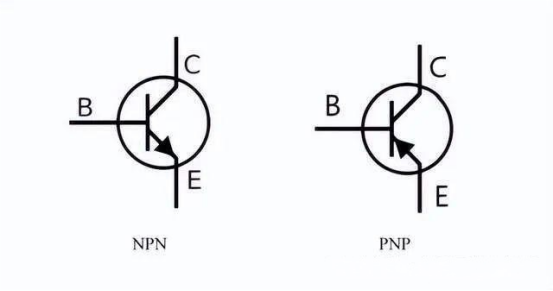
III. How to Use a Digital Multimeter to Determine if a Transistor is NPN or PNP?
Sometimes, the transistor's markings are unclear, or you might not have internet access to look up its specifications. In such cases, a digital multimeter can be used for identification.
Method / Steps:
1. Set the multimeter to diode test mode.
2. Place the red probe on the middle pin and the black probe on the left pin. Check for a reading. If you get one, the red probe is contacting the P-side, and the black probe the N-side of a junction. If there's no reading, reverse the probes (black on middle, red on left) and test again. (If you get no reading both times, the transistor might be faulty.)
3. Use the same method to test between the middle pin and the right pin. From the readings, you can deduce the semiconductor type of each pin. For example, if the middle pin tests as P-type relative to both outer pins (which test as N-type), then the transistor is an NPN type.
If your multimeter has a more advanced feature:
· Switch the dial to the hFE (transistor gain) mode.
· There is a dedicated transistor test socket, usually labeled. First, guess that the transistor is PNP. Insert its three leads into the set of holes labeled for PNP transistors. Try different pin configurations. If the display shows a reading of '0' for all configurations, it's likely not a PNP type.
· Next, insert the transistor into the set of holes labeled for NPN transistors. Try different pin arrangements. If you get a valid numerical reading (like 11 or 258 in the example), then the transistor is confirmed as NPN. Furthermore, the labels (E, B, C) next to the sockets that give the highest, most stable reading indicate the correct pinout (Emitter, Base, Collector) for your specific transistor. In the example diagram, the transistor is NPN, and with the flat side facing you, the pins from left to right are Emitter, Base, Collector.
IV. Conclusion
Mastering the method of identifying transistor types with a digital multimeter is an incredibly useful skill. The process is not only simple and practical but also reinforces the fundamental principle of PN junctions in semiconductors. By getting hands-on and practicing this technique, you'll not only solve practical identification problems quickly but also deepen your understanding of the transistor's internal structure.


