
DIY AC Battery Internal Resistance Test


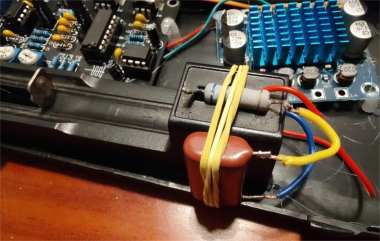
If you are interested in DIY internal resistance test setups, you might want to take a look at this article.
You can gather the parts and assemble an AC internal resistance measurement setup yourself. The measured value will be much lower than DC internal resistance, roughly about half of it. This result is not caused by random error, unlike DC internal resistance measurements that require time estimation.
The sine wave from the signal generator is not perfectly clean. If it is difficult to fine-tune the frequency, you can set it to 1 kHz, roughly within ±50 Hz, which is not a big issue.
The small board with the blue heatsink can use a digital power amplifier, 32 W dual channel, powered by 12 V, sharing the same power supply as the signal generator.
Adjust the signal generator so that the amplifier outputs a 5 V sine wave (RMS, same below).
The DC blocking capacitor is 3.3 µF, and the shunt resistor is 0.6 Ω. On the oscilloscope, you measure 80 mV across the shunt, which corresponds to a current of 133 mA, and from this you can calculate the battery internal resistance. Just divide the voltage data by the current data. The probes are connected directly to the battery terminals using a Kelvin four-wire connection.
The 555 circuit mentioned in the forum section may have some issues. A square wave cannot be treated the same as a sine wave. Since the standard specifies a 1 kHz sine wave, the harmonics of a 1 kHz square wave may interfere with the measurement. In addition, if you want to correctly measure a 1 kHz square wave, at the very least you need a multimeter with a 10 kHz frequency response. The UNI-T 61E is rated at 1 kHz, while most low-end meters are only 100 Hz or 200 Hz. Only benchtop meters or higher-end handheld meters can reach 10 kHz.
If your capacitor value is too small or the shunt resistor is too large, the voltage drop across the battery will be too small, and the error will definitely be large.
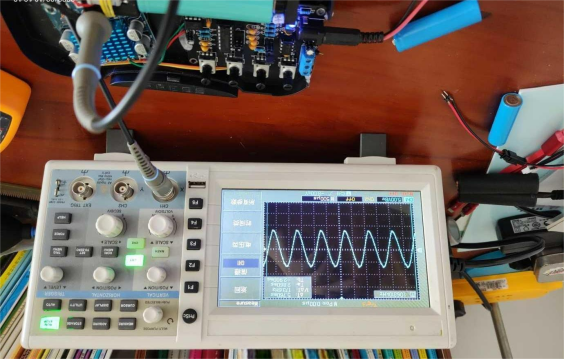
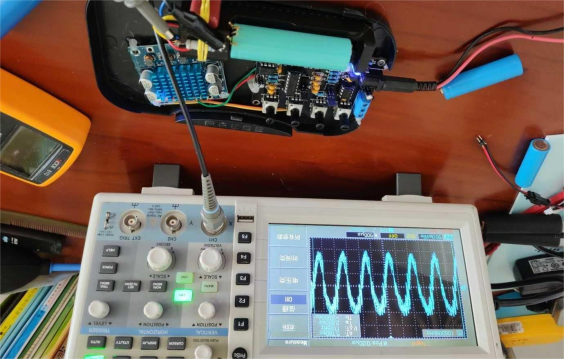
The test current can potentially reach 1 A, but around 500 mA is usually sufficient. The key limitation is the power rating of the shunt resistor. The resistor shown in the diagram already gets warm at 700 mA. If you can find a thicker one, 1 A is a good choice, and even an ordinary multimeter should be usable, even if its frequency response is not ideal. At 700 mA, when a Victory VICTOR 81D with a 200 Hz frequency response measured a battery internal resistance of 33 mΩ, the oscilloscope reading was 43 mΩ. It is estimated that at 1 A the results would be very close. At 80 mA, the oscilloscope measured 50 mΩ for the same battery, while the multimeter showed 12 mΩ.
The current is mainly limited by the capacitor. With a 22 µF capacitor, the current is about 700 mA. The input is 5 V RMS in all cases. If you use a 4½-digit multimeter with a 10 kHz frequency response, the 555 solution is very reliable, even with a square wave.
An oscilloscope is not really designed for voltage measurement. Its so-called accuracy cannot be compared with that of a multimeter, since a multimeter's accuracy is at least one to several orders of magnitude higher. Just look at the oscilloscope probes, with 10× attenuation and then another 10× amplification inside the instrument, and you can imagine how limited the voltage accuracy is.
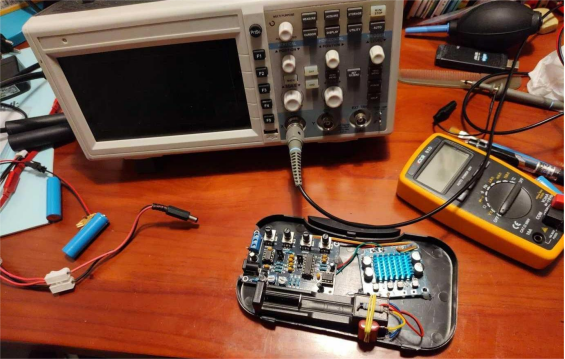
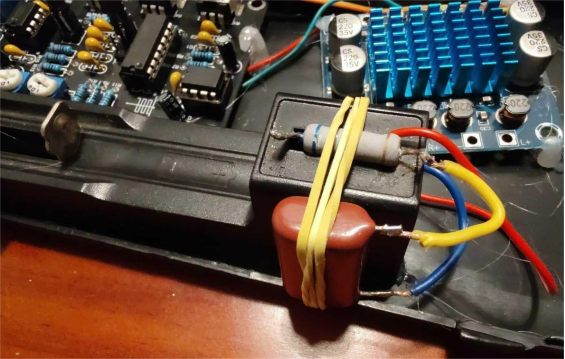
The circuit is simply a high-power (32 W) amplifier outputting a 5 V, 1 kHz sine wave, passing through a 20–30 µF DC-blocking capacitor for coupling and voltage reduction, and then directly into the battery through a 0.6 Ω shunt resistor. By measuring the AC sine-wave voltage across the shunt, you can calculate the current, and then measure the voltage across the battery. Dividing voltage by current gives the internal resistance. The two voltages must be measured separately, which is the Kelvin four-wire principle and helps eliminate contact resistance.
The main factor affecting accuracy is voltage measurement. For a 1 kHz sine-wave voltage, the multimeter's specified frequency response should be at least 1 kHz. If you use a 1 kHz square wave, the meter should reach at least 5 kHz. As for the minimum detectable value, as long as the current is large enough, it is not a big problem. If the current is only tens of milliamps, you need at least a 5-digit meter. With a 6-digit meter, a test current of just a few milliamps should be sufficient.
Finished.


