
What's the Difference Between NMOS and PMOS?


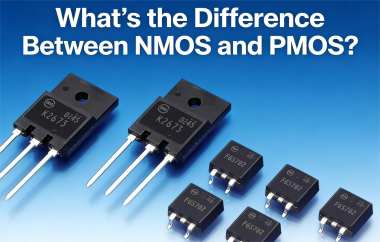
In today's electronic components industry, NMOS and PMOS, as the two core types of Metal-Oxide-Semiconductor Field-Effect Transistors (MOSFETs), form the foundation for nearly all modern digital and analog circuits. Their cooperative operation enables efficient performance from microprocessors to power management systems, and understanding the fundamental differences between them is essential for circuit design. This article starts with the basic concepts and systematically explains the key differences between NMOS and PMOS in terms of conduction characteristics, power loss, and driving methods.
Catalog
III. Differences Between NMOS and PMOS
I. What is NMOS?
NMOS stands for N-Channel Metal-Oxide-Semiconductor Field-Effect Transistor, and its internal structure consists of n-type source and drain regions diffused on a p-type substrate. When a positive voltage higher than the source voltage is applied to the gate, an n-type conductive channel forms on the substrate surface, allowing electrons as the main charge carriers to flow between the source and drain, thereby achieving conduction. The high mobility of electrons gives NMOS faster switching speeds and lower on-resistance, making it particularly suitable for high-speed digital logic and efficient power switching applications.
II. What is PMOS?
PMOS stands for P-Channel Metal-Oxide-Semiconductor Field-Effect Transistor, and its structure consists of p-type source and drain regions diffused on an n-type substrate. When a voltage lower than the source voltage is applied to the gate, holes act as the main charge carriers and conduct current through the channel. However, since hole mobility is much lower than electron mobility, PMOS has slower switching speed and higher on-resistance. Despite this, PMOS still plays a unique role in applications requiring high-side switching, logic level pulling, or low static power consumption. In most modern integrated circuits, NMOS and PMOS are often used together to form complementary MOS (CMOS) circuits, achieving low static power consumption and stable logic levels.
III. Differences Between NMOS and PMOS
In practical electronic applications, the core differences between NMOS and PMOS mainly lie in conduction characteristics, MOSFET power losses, and MOSFET driving.
1. Conduction Characteristics
NMOS conducts when the gate-to-source voltage (VGS) is greater than the threshold voltage (Vth, positive), making it ideal for low-side switching where the source is connected to ground. NMOS is fully turned on when the gate voltage is raised to the supply voltage (VDD). On the other hand, PMOS conducts when VGS is less than the threshold voltage (Vth, negative), naturally making it suitable for high-side switching where the source is connected to the supply. PMOS turns on when the gate voltage is pulled down close to ground. A simple design rule is to use NMOS for low-side signals and PMOS for high-side signals.
2. MOSFET Power Loss
Both NMOS and PMOS experience losses mainly from conduction loss and switching loss. Conduction loss is caused by the on-resistance (RDS(on)), and because electrons have higher mobility, NMOS generally has lower RDS(on), resulting in less heat for the same current. Switching loss occurs during the transitions between on and off, when voltage across the transistor and the current flowing through it overlap, producing power loss. The higher the switching frequency, the greater this loss becomes. For both NMOS and PMOS, reducing switching time and lowering the switching frequency are effective ways to minimize switching loss.
3. MOSFET Driving
Compared with bipolar transistors, MOSFETs generally do not require continuous current to turn on; applying a sufficient gate-to-source voltage is enough. This is easy to achieve, but speed is also important. Within the MOSFET structure, there are parasitic capacitances between the gate and source or drain, and driving a MOSFET is essentially charging and discharging these capacitances. Charging the capacitance requires current, and since the capacitance can be considered a short circuit momentarily, the instantaneous current can be quite high. When selecting or designing MOSFET drivers, the first consideration is the ability to provide sufficient instantaneous current. The second consideration is that for NMOS commonly used in high-side driving, the gate voltage must be higher than the source voltage to turn on. Since the source voltage is the same as the drain voltage (VCC) in high-side driving, the gate voltage may need to be 4V or 10V higher than VCC. To achieve a voltage higher than VCC within the same system, a dedicated boost circuit is required. Many motor drivers integrate charge pumps, and it is important to select appropriate external capacitors to provide enough short-circuit current to drive the MOSFET.
IV. Conclusion
NMOS and PMOS, as the two fundamental types of MOSFETs, play different functional roles in electronic component design. NMOS uses electrons as the main charge carriers, giving it fast conduction, low on-resistance, and high efficiency, which makes it advantageous in high-speed and high-current driving scenarios. PMOS uses holes as the main charge carriers, offering high-side driving and logic level pulling capabilities that are sometimes irreplaceable in certain circuit configurations. When combined with NMOS to form CMOS circuits, they achieve optimal power efficiency and logic performance.


