
TI Starts 300mm Wafer Production at Sherman Fab


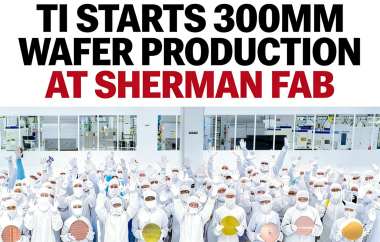
Texas Instruments (TI) has officially brought its new semiconductor fab in Sherman, Texas, online, marking the start of 300mm wafer production at its first facility, SM1. The company has already begun shipping chips to customers and plans to ramp output to tens of millions of devices per day as production scales.
The Sherman fab is part of TI's previously announced long-term commitment to U.S. manufacturing, with up to $60 billion planned for domestic semiconductor investment. Within Sherman alone, TI expects to invest around $40 billion to build four fabs in total. Alongside SM1, construction of the second fab, SM2, is already underway, while SM3 and SM4 are planned for future phases.
TI President and CEO Haviv Ilan said the launch of the Sherman fab highlights the company's core strength: controlling its manufacturing process end to end to deliver foundational semiconductors used across nearly all electronic systems. As the largest U.S.-based maker of analog and embedded processing chips, TI believes its ability to run high-volume, reliable 300mm manufacturing at scale gives it a clear long-term advantage.
SM1 will primarily focus on power management chips used in automotive systems, battery-powered electronics, vehicle lighting, and data center power infrastructure. Mark Gary, Senior Vice President of TI's Analog Power business, noted that ongoing advances in the company's power portfolio are helping improve power density, extend battery life, cut standby power, reduce electromagnetic interference (EMI), and shorten EMI certification cycles. According to Gary, products coming out of the Sherman fab are expected to quickly influence real-world system design and performance.
The move to 300mm wafers is also a major efficiency upgrade for TI. The company has begun winding down operations at older fabs that produced 150mm wafers, which offer only a quarter of the surface area of 300mm wafers. This transition significantly boosts output while lowering manufacturing cost per chip. TI added that the Sherman site is expected to create up to 3,000 direct jobs, with priority given to employees affected by the closure of older facilities.
Overall, the Sherman fab represents a key milestone in TI's strategy to expand capacity, strengthen supply resilience, and support long-term demand for analog and power semiconductors across automotive, industrial, and computing markets.


