
How to Test Switching Diode Quality?


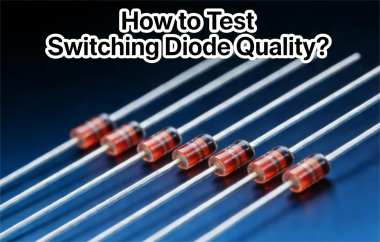
In electronic circuit design and repair work, switching diodes play a critical role. They act like high-speed gates in a circuit, specifically responsible for controlling current flow and cutoff within extremely short time periods, and their performance directly determines the efficiency and stability of applications such as switching power supplies, digital logic circuits, and high-frequency signal processing. A low-quality switching diode can cause slow circuit response, increased power consumption, and may even lead to complete system failure. This article systematically explains the core characteristics of switching diodes and introduces a complete measurement process, from polarity identification to performance evaluation.
Catalog
II. Characteristics of switching diodes
III. How to measure the quality of a switching diode?
I. What is a switching diode?
A switching diode is a type of diode specifically designed to switch quickly from the conducting state to the cutoff state, or from cutoff to conduction, and compared with ordinary rectifier diodes, its main advantages are shorter response time and lower stored charge. Switching diodes are typically made of silicon, with common models such as the 1N4148 series, and are widely used in high-frequency pulse circuits and logic signal processing. Structurally, they are still based on a PN junction, but the carrier recombination and storage processes are optimized to achieve faster switching speed and lower reverse recovery time. Because of their key role in high-speed circuits, quality evaluation of switching diodes mainly focuses on whether their electrical and dynamic characteristics meet specification requirements.
II. Characteristics of switching diodes
To accurately evaluate the quality of a switching diode, it is necessary to fully understand several key performance parameters, as these parameters directly define its switching capability and application scope.
Switching time is the core indicator of speed and mainly includes turn-on time, which is the time required to switch from the cutoff state to conduction, and reverse recovery time, which is the time required to switch from conduction to full cutoff. In most cases, due to charge storage effects, the reverse recovery time is much longer than the turn-on time, so datasheets usually list reverse recovery time as the primary specification. High-quality switching diodes have extremely short reverse recovery times, for example, the typical value for the silicon switching diode 1N4148 is only about 4 nanoseconds, allowing it to handle very steep pulse signals.
Forward characteristics include forward voltage drop and rated current. When conducting, a relatively stable voltage drop appears across the diode, with a typical value of about 0.6 to 0.7 V for silicon devices. At the same time, each diode has limits for maximum continuous forward current and peak surge current, which must not be exceeded in use. Reverse characteristics include reverse breakdown voltage and reverse leakage current. The reverse breakdown voltage is the maximum reverse voltage the diode can withstand, and exceeding this value will damage the device. Reverse leakage current is the small current that flows under a specified reverse voltage, and ideally it should be zero, with higher-quality diodes having smaller leakage currents, typically at the nanoampere level.
III. How to measure the quality of a switching diode?
1. Polarity identification
Set the multimeter to the R×100 or R×1k range and connect the two probes to the two terminals of the diode. After taking one measurement, swap the probes and take another reading. Among the two results, one will show a higher resistance value, which is the reverse resistance, and the other will show a lower resistance value, which is the forward resistance. In this case, the black probe is connected to the positive electrode of the diode, and the red probe is connected to the negative electrode.
2. Detection and evaluation of unidirectional conduction performance
Generally, germanium diodes have a forward resistance of about 1 kΩ and a reverse resistance of about 300 Ω. Silicon diodes usually have a forward resistance of around 5 kΩ, while the reverse resistance is infinite. A smaller forward resistance and a larger reverse resistance are preferred, and the greater the difference between forward and reverse resistance values, the better the unidirectional conduction characteristic of the diode. If the measured forward and reverse resistances are both close to zero or very small, it indicates an internal short circuit or leakage failure. If both forward and reverse resistance values are infinite, it means the diode has failed open-circuit.
3. Measurement of diode reverse breakdown voltage
The reverse breakdown voltage, or voltage withstand value, can be measured using a transistor DC parameter tester. During measurement, set the tester's NPN/PNP selector to the NPN position, insert the positive electrode of the tested diode into the C socket and the negative electrode into the E socket, then press the V(BR) key, and the tester will display the diode's reverse breakdown voltage. A megohmmeter and a multimeter can also be used to measure reverse breakdown voltage. During testing, connect the negative electrode of the tested diode to the positive terminal of the megohmmeter and the positive electrode to the negative terminal of the megohmmeter, while monitoring the voltage across the diode with a multimeter set to an appropriate DC voltage range. Slowly rotate the megohmmeter handle, gradually increasing speed, and when the voltage across the diode stabilizes and no longer rises, that voltage value is the diode’s reverse breakdown voltage.
IV. Conclusion
As a key component enabling high-speed switching functions in electronic systems, the quality evaluation of switching diodes should be carried out through systematic analysis of both static and dynamic characteristics. Static testing can be performed using a multimeter or parameter test equipment to assess basic electrical properties such as forward voltage drop and reverse leakage current, while dynamic performance requires oscilloscopes and test platforms to measure parameters like reverse recovery time. Only by fully understanding these characteristics and comparing them with datasheet specifications can the true performance of a switching diode be accurately judged, which not only helps ensure circuit performance but also provides a solid foundation for the reliability and stability of electronic products.


