
How to Distinguish Zener Diodes and TVS Diodes?


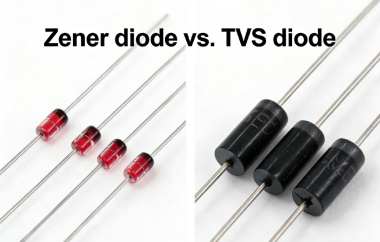
Voltage Regulator Diodes and TVS Diodes are two common types of diodes in electronic circuits. They may look similar on the outside, but their functions are very different, and choosing the wrong one can directly lead to circuit failure or damage. Many engineers and hobbyists get confused when selecting components. This article will explore the fundamental differences between the two and provide specific methods to distinguish them from appearance to electrical characteristics.
Catalog
I. What is a Voltage Regulator Diode?
I. What is a Voltage Regulator Diode?
A Voltage Regulator Diode, also known as a Zener Diode, is a semiconductor device that takes advantage of the PN junction’s ability to maintain a stable voltage after reverse breakdown. When it is in reverse breakdown, even if the current through it varies over a wide range, the voltage across its terminals remains nearly constant. Therefore, its primary function is to provide a precise voltage reference or perform low-voltage regulation. It is commonly used as a reference voltage source in analog circuits or in simple voltage regulation stages in power supplies. The Voltage Regulator Diode needs to continuously operate in the reverse breakdown region, consuming power steadily to maintain a stable voltage.
II. What is a TVS Diode?
A TVS Diode, short for Transient Voltage Suppression Diode, is a semiconductor protection device specifically designed to guard against sudden high-voltage pulses. Under normal circuit voltage, it presents high impedance and has minimal effect on system operation. When the circuit experiences transient voltage spikes caused by events such as electrostatic discharge, lightning induction, or inductive load switching, the TVS Diode quickly switches to a low-impedance state. It redirects excess surge current to ground, clamping the voltage at the protected device to a safe level. Its core purpose is to absorb large energy pulses in a very short time to protect sensitive electronic components downstream from damage.
III. How to Distinguish Them?
To effectively distinguish between Voltage Regulator Diodes and TVS Diodes, several specific aspects can be considered.
1. Symbols and Packaging
Although Voltage Regulator Diodes and TVS Diodes share many similarities in circuit symbols and physical packaging, it is difficult to tell them apart based on appearance alone if parameters are not labeled. Some TVS Diode symbols include distinctive bidirectional arrows indicating their bidirectional suppression capability, while Voltage Regulator Diode symbols are closer to standard Zener symbols. The most reliable way to identify them is to refer to the device model and datasheet, rather than just judging by appearance.
2. Circuit Connection
Both Voltage Regulator Diodes and TVS Diodes are typically connected in reverse in a circuit, taking advantage of their characteristics in reverse breakdown to achieve voltage control or voltage clamping. The Voltage Regulator Diode is connected to maintain a specific stable voltage at a certain point in the circuit and can serve as a simple regulation element in power or reference voltage networks. TVS Diodes, on the other hand, are usually connected in parallel with the protected line. When a transient overvoltage occurs, they conduct rapidly to limit the peak voltage and then return to high impedance, without participating in steady-state voltage regulation.
3. Response Time
Response time is an important indicator for distinguishing their purposes. Voltage Regulator Diodes focus primarily on the regulated voltage, and response time is not a critical design factor. They conduct when breakdown voltage is reached but are not intended to handle extremely fast transients. In contrast, TVS Diodes are designed for very fast response to effectively suppress overvoltage events, typically in the nanosecond range or faster. This ensures they conduct at the onset of a high-energy spike and clamp the voltage immediately.
4. Power Rating
Voltage Regulator Diodes generally have low power ratings, typically 1W or 2W, and their maximum power is limited by the device’s thermal dissipation capacity. They are suitable for low to medium power voltage regulation applications, and their current and power handling capability is relatively limited. TVS Diodes, however, are designed to absorb sudden high-energy pulses, with peak pulse power ratings that can reach hundreds or even thousands of watts. This high power can only be sustained for a very short duration and is not suitable for continuous voltage regulation.
IV. Conclusion
In summary, the key to distinguishing these two types of diodes is understanding their fundamental purpose. Voltage Regulator Diodes are active voltage regulators used to provide stable DC voltage, while TVS Diodes act as standby circuit protectors against transient voltage spikes. In practical applications, if stable voltage is needed, a Voltage Regulator Diode should be chosen with attention to its regulated voltage and continuous power rating. If protection from sudden overvoltage is required, a TVS Diode should be selected, considering its clamping voltage and pulse power. Ultimately, the most authoritative and accurate guidance for distinguishing and selecting components comes from the official datasheets provided by the manufacturers.


