
NOR Flash Prices Could Jump 30%–100%


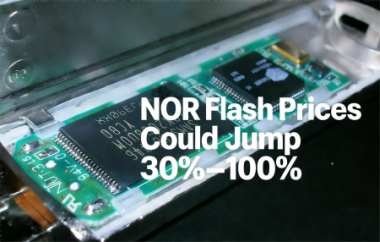
Recently, the once relatively balanced NOR flash market has entered a period of sharp volatility. According to supply chain insights, global semiconductor capital spending has been heavily skewed toward AI-driven products such as HBM and DDR5, squeezing capacity for mature process nodes used in automotive, industrial control, networking, and consumer electronics. This imbalance has created a clear structural gap in NOR flash supply, with market expectations pointing to price increases of roughly 30% to 100% by the first quarter of 2026.
As a global leader in NOR flash, Taiwan-based memory maker Macronix is widely seen as a key beneficiary of this shift. Its stable manufacturing base and broad exposure across automotive, industrial, and embedded applications have attracted growing attention from institutional investors. Meanwhile, although a mainland China memory player has announced plans to expand 19 nm DRAM production, building and validating new lines—from cleanroom construction to equipment qualification—typically takes 18 to 36 months. This means near-term supply tightness in NOR flash is unlikely to ease quickly.
The market has effectively moved into a "capacity decides pricing" phase. Companies with established mature-node production are gaining the upper hand, opening a rare profitability window for Taiwan's memory sector. Within this ecosystem, Macronix remains focused on NOR flash, while Nanya Technology and Winbond concentrate on DRAM, with Winbond also maintaining a flash portfolio. Firms such as ESMT and Etron specialize in niche memory designs, Phison targets SSD controller solutions, Powerchip supports foundry services, ChipMOS handles packaging and testing, and related channel partners complete the value chain. As prices for mature memory products continue to rise, the entire ecosystem is positioned to benefit.


